When the “Beano” Burst was stolen, Eric Clapton needed a replacement, fast. Here’s a close look at the 1960 Les Paul Standard that was heard around the world on Cream’s landmark debut album
There’s no doubt that Eric Clapton’s fiery guitar playing on The Bluesbreakers’ 1966 “Beano” album remains a high-water mark for electric blues and a key inflection point in the 75-year story of the Gibson Les Paul™. But when the 1959 Les Paul Standard he used on that legendary record was stolen during rehearsals with Clapton’s new power trio, Cream, it was Andy Summers—then another emerging guitarist in the London music scene—who provided the replacement.
The 1960 Les Paul Standard that Summers sold to Clapton for £300 would go on to feature on Fresh Cream, a long player at the bleeding edge of rock’s fast-moving evolution that combined blues, jazz, pop, and psychedelic influences with Clapton’s searing, unmistakable lead guitar.
 The Gibson 1960 “Fresh Cream” Les Paul Standard as it appears today, complete with modified headstock
Six decades later, as Gibson prepares to honor another of Clapton’s iconic Cream guitars with the forthcoming Epiphone Inspired by Gibson Custom Eric Clapton 1964 ES-335TDC™ Reissue, the “Fresh Cream” Burst—sometimes also referred to as the “Summersburst”—has resurfaced.
After spending decades in a private collection, the guitar was recently acquired by Matthieu Lucas of Matt’s Guitar Shop in Paris, where we traveled with acclaimed guitar photographer Eleanor Jane to get hands-on with a Les Paul whose tone is familiar to millions, but whose whereabouts were a mystery for many years.
 New York luthier Matt Umanov is believed to have crafted the F-5 mandolin-inspired replacement headstock
Feelin’ Fade-Free
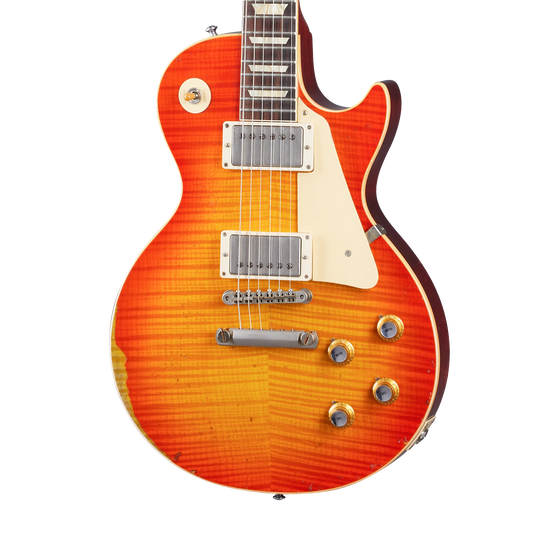
On opening the case and seeing the guitar in person for the first time, everything at the body end checks out. It’s clearly a late-1960 Les Paul Standard with attractive figuring and the tangerine-hued Cherry Sunburst finish typical of the period, following the move to a more colorfast red that withstood fading better when exposed to UV light than the aniline dye used on earlier Bursts.
The pickup covers have been removed—consistent with period images of Clapton playing the guitar in late 1966—and the bridge unit is a Patent Number humbucker™ that was apparently fitted to replace the original P.A.F. that was already malfunctioning when Andy Summers still owned the instrument.
 Though the bridge pickup was swapped for a Patent Number unit, the original neck P.A.F. remains in situ
And then there’s the elephant in the room. The headstock the guitar wears today is clearly not the one it left Kalamazoo with back in 1960. Instead, it has been replaced with a design inspired by an F-5 mandolin featuring both Clapton’s name and what appears to be his silhouette inlaid into it in mother-of-pearl, over which a clear lacquer coat has yellowed with time.
Jumbo fretwire sits above the binding and is clearly a later addition, while the neck has the skinniest profile we’ve ever encountered on a Burst—even by the standards of the slim-necked instruments that left the factory shortly before the single-cutaway Les Paul Standard was discontinued at the end of 1960.
 The back of the neck reveals the scarf joint where the replacement headstock was grafted on
Rollin’ and Tumblin’
Matthieu Lucas believes that Clapton broke the guitar’s headstock twice during his time with it—and still images from Cream’s debut television performance on UK show “Ready Steady Go!” in November 1966 seem to show a rather ugly repaired break across the width of the headstock.
Another break at some point in the spring of 1967 apparently saw the guitar sent to Dan Armstrong’s repair shop in New York, where luthier Matt Umanov is believed to have crafted the mandolin-inspired replacement headstock, possibly shaving down the neck to its current dimensions during the process.
 The jumbo fretwire and straplock were later additions
The story goes that Clapton is believed to have been unhappy with the repair, abandoning the guitar in New York and moving on to other Gibsons like the aforementioned ’64 ES-335 and the “Fool” SG™ we examined in detail when it hit the auction block earlier in 2026.
The modified 1960 Les Paul Standard passed through the hands of several owners until the mid-1980s. In 1986, it was purchased by a collector who kept it for nearly four decades before ultimately being convinced to part with it by Matthieu Lucas in 2026.
 The maple top on this famous 1960 Les Paul Standard has a beautiful flame
Sometimes, encounters with iconic vintage instruments prove to be unsatisfying because they reveal little of the guitar player who made them famous—and indeed this guitar has changed considerably since Eric Clapton wielded it in 1966. However, its essential sonic character remains intact and the bite of the Patent Number bridge pickup alongside the well, creamy neck P.A.F. combine to put the sound of Fresh Cream at your fingertips, 60 years after the album was committed to tape.
Follow Gibson on Instagram for more images. Shop Gibson Les Pauls and find out more about the 1964 Gibson SG played by Eric Clapton in Cream.