The world’s greatest guitar collection is set for auction at Christie’s on March 12. Here, Tony Bacon takes a look at a guitar that featured on U2’s Joshua Tree world tour, with new photography by Eleanor Jane
In the 70s at Gibson, Les Pauls were central to the solidbody electric lines, with several variations coming and going. SGs, too, enjoyed a decent showing. But it had been about 15 years since Gibson had offered an Explorer. You’ll know about the original Explorer, that angular guitar launched in 1958 alongside the Flying V—unsuccessfully at the time but now revered as one of the great electric designs.
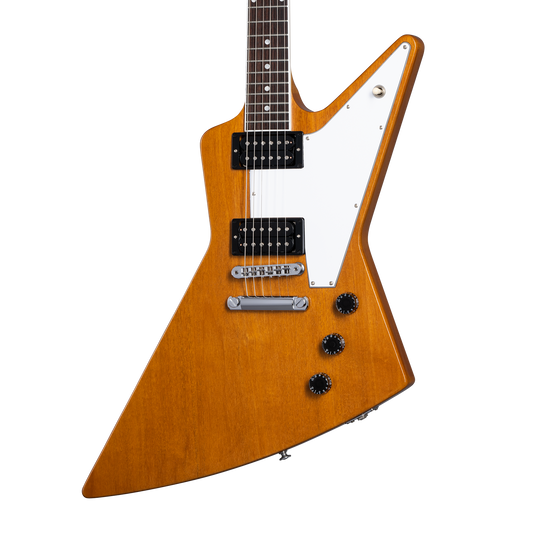
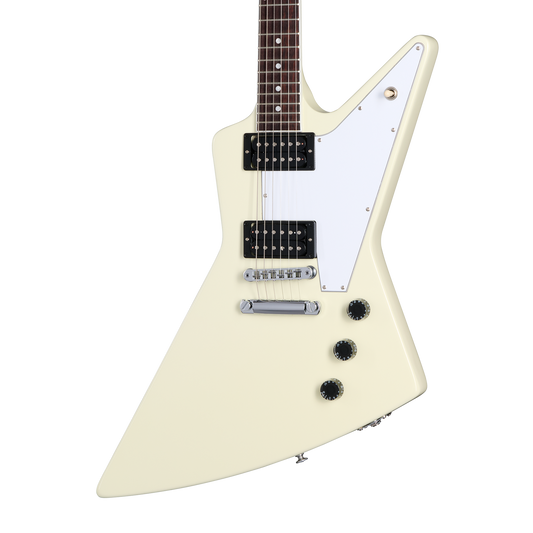
In 1975, Gibson bosses decided it was time for a revival. One catalog called the new model The Explorer, noting it as a limited edition, and describing it as “a copy of the rare 1958 model.” Features included “select mahogany with natural finish” and gold-plated metalwork, along with original-style white pickguard, humbuckers, and controls.
 This 1976 Gibson Explorer featured on the Joshua Tree tour
One of the guitarists drawn to the new Explorer was The Edge from U2. On holiday in the 70s in New York City with his parents, the teenage Edge spied one in a music store. He recalled later that at that stage he didn’t really have a clue what he wanted guitar-wise—but had a good idea of what he didn’t want.
In the New York store, he tried a few instruments, as you do, rejecting this or that model as he went. “Then I picked up the Explorer, with its strange shape,” he told Chas de Whalley a few years later for Guitar Heroes, “and there seemed to be so much more variety in the sounds I could get from it.”
 The Explorer returned to the Gibson calatog in the mid-1970s
He found the neck pickup on the guitar pleasantly mellow, while the bridge pickup seemed usefully powerful, but it also had a clarity that appealed to him. “It had none of that rasping, growling distortion you get from a Les Paul,” he continued in his interview with de Whalley.
“The top strings sounded richer, too, where the Les Pauls were all on the thin side. I could play little chords on the top three strings and they’d feel really full. My style is based on a lot of broken chords and picking, and the Explorer seems to be quite the perfect guitar for it.”
 The back of the guitar shows evidence of plenty of playing time
I asked Edge about the guitar when we talked at Windmill Lane studio in Dublin in 1986 as U2 were about two-thirds of the way through recording what became The Joshua Tree. I asked him about the Explorer, which by then had become a much-used and important guitar—and for some time it had been his only guitar.
Steve Lillywhite, producer of the band’s first three albums, was apparently amused by this single-mindedness. When U2 recorded their first album, Boy, in 1980, Steve was surprised to find such a lean set-up confronting him from the other side of the glass. Edge told me: “Steve had just come off an XTC album, and he’d tut and say, ‘They have all these guitars, and so the big debate with them was: Which one will we use? Edge has only got the one!’ There was no debate for us. It was just: Is it in tune? OK, off we go! He thought this was quite funny. The idea of guitars for each different sound—well, really, the guitar to me was kind of not very important,” Edge concluded. “It was all about what you did with the basic sound.”
 There is no shortage of evidence of playwear on the front, either
Gradually, it became evident that he needed some backups for that prized Explorer—and that leads us to an ex-Edge ’76 Explorer, one of the guitars offered in the mighty sale of the Jim Irsay collection coming soon to Christie’s, from which we have previously profiled Gibson SGs formerly owned by George Harrison and Eric Clapton. Edge’s guitar tech Dallas Schoo told Guitarist magazine in 2009 that, given the importance of Edge’s original Explorer, he finally convinced him to leave it at home and nip things in the bud while he could. He turned up three similar ’76 Explorers—quite an achievement given their scarcity.
“The right ones are hard to find,” Dallas continued, “because Gibson had two different Explorers in production that year. The ones that were produced from June through December had a thin neck, but the models that were produced during the first part of that year had a thick baseball-bat neck. Those are the ones Edge prefers. Gibson didn't make many of them, only about 1,800 of them or so, and people hang on to them. Finding a few of them that were just right took some detective work.”
 The clarity of the bridge pickups on Explorers of this era is something The Edge finds appealing
The guitar for sale at the Irsay auction was one of those ’76 Explorers that Dallas found—this one surfaced in Cincinnati—and Edge said he used it during the Joshua Tree world tour in ’87 and many U2 tours since. Apart from its importance in the hands of Edge, it’s worth taking a look at its specs, too.
It has all you’d expect in line with the catalogue features we talked about earlier—except that Christie’s specify the guitar’s timber as korina. That was the wood used for the original late-50s Explorer, certainly, and while most of these 70s reissues were made from mahogany, some of the 1976 examples were indeed in korina. This guitar may be one of those.
 Much of the gold plating has worn away from the tailpiece
The rear of its headstock has what you’d want to see in a ’76 Explorer: a stamped “Limited Edition/Made in U.S.A.” and a serial number starting with two zeroes. Either side of that, though, is an impressed “K” to the left and a “2” to the right. The K is presumably to indicate korina, though it could conceivably indicate the Kalamazoo factory, and a 2 on a Gibson of this period usually indicates a second, a guitar with some minor blemish or other slight imperfection.
Aside from all this trainspotter stuff, the lucky new owner of the guitar will, according to Edge, be able to achieve “most of the sounds of the Boy, October, and War albums”. All they’ll need to hand in addition to the Explorer, he said, is an Electro-Harmonix Deluxe Memory Man and a Vox AC30. Now there’s a nice project for some rainy afternoons.
The Jim Irsay Collection: Hall of Fame auction takes place at Christie’s in New York on March 12. Tony Bacon’s latest book is “Electric Blues: T-Bone Walker & The Guitar That Started It All,” available now exclusively at Regent Sounds.