As the famous 1964 Gibson SG goes under the hammer as part of the upcoming Christie’s Jim Irsay Collection: Hall of Fame auction, Tony Bacon explores its colorful history alongside photography from Eleanor Jane
When Eric Clapton wrote his autobiography in 2007, he mentioned the underground art scene in London in the late ‘60s where, as he put it, “seminal influences were suddenly showing up out of nowhere, like they had come out of the woodwork.” He pointed to one prime example. Marijke Koger and Simon Posthuma were two Dutch pop artists who moved to London in 1966 and later started an art collective (and, briefly, a band) that they called The Fool.
Marijke told me: “We found a great Georgian-style place for rent in St. Stephen’s Gardens in Bayswater, quite run down and dilapidated, but with large rooms. We had two floors, the upper story being the studio with plenty of space to paint and store artwork. This is where we met with the Cream guys for hanging out and photo shoots as well as with The Beatles and other celebrities later.”
 The SG was customized in 1967 by Dutch art collective, The Fool
Eric went to see Marijke and Simon in that studio in March ’67 with a specific commission in mind. The pair were known, Eric said, for painting “mystical themes in fantastic vibrant colors.” He asked them to decorate one of his guitars, “which they turned into a psychedelic fantasy.”
At this point, Eric had been through a couple of Les Pauls—both Bursts, and each stolen in turn during the last nine months or so. Perhaps he thought this type of Les Paul™ was somehow jinxed? Whatever his motives, he went out that March and instead bought a circa-1964 SG™ Standard in Cherry.
Clapton knew about the sonic and tonal advantages of humbuckers and the regular Gibson control layout from his Les Paul Standards, but this guitar was obviously different, with its double-cut sculpted body and an overall lightness, accessibility, and range. Beyond playability, though, the prospect of that psychedelic fantasy called out to Eric.
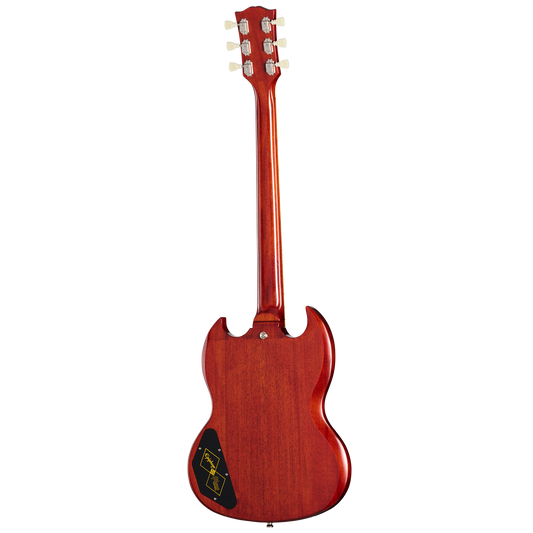
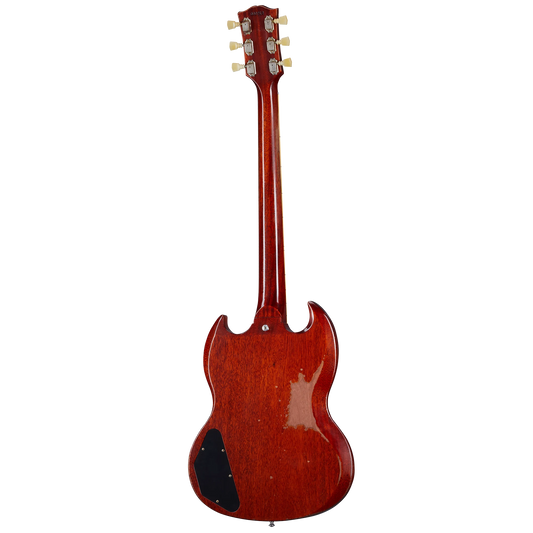
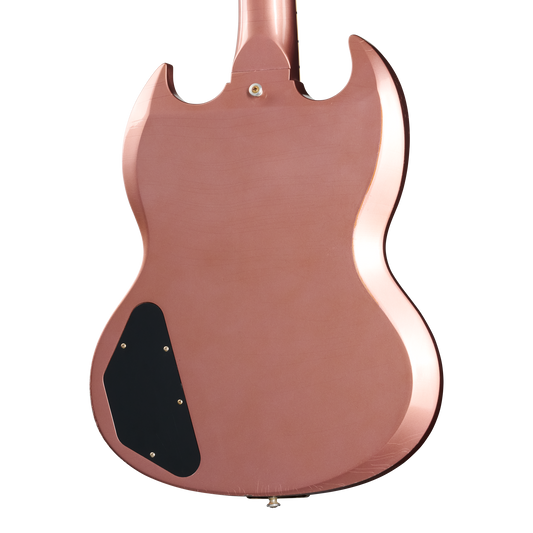
 The back of The Fool continues the psychedelic theme
Marijke and Simon set to work. On the SG’s body they painted a perky winged sprite playing a triangle—its curly hair not dissimilar to Eric’s look at the time—which they set among stars and flames and clouds on a ground of blues, purples, and greens. For the pickguard, they chose a scene with a path stretching to a fat red sun over distant mountains.
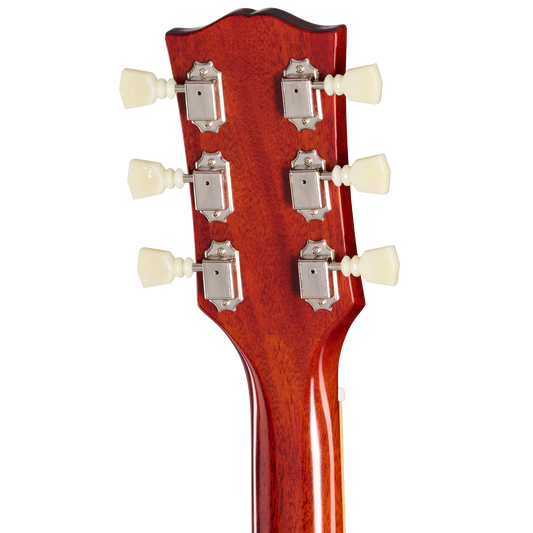
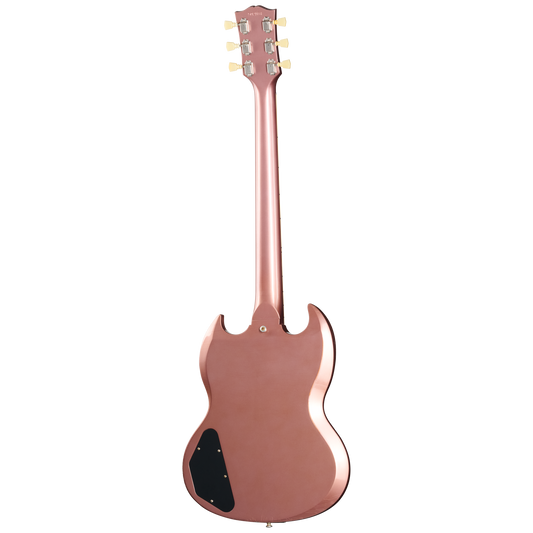
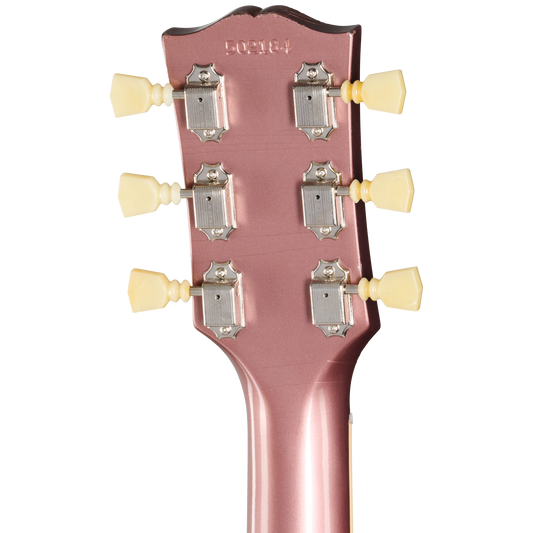
Graduated curves in oranges, browns, and yellows followed the body’s cutaways, echoed in waves of color on the headstock and on the rear of the neck. Finishing the back of the body, the pair painted colored waves and intense concentric circles ranging from greens into reds and bright yellows. Far out, indeed.
They also psychedelicized other items in the Cream arsenal, namely Jack Bruce’s Fender VI and Ginger Baker’s bass drum heads. Jack disliked the feel of the paint and replaced his sticky VI with a Gibson EB-3. Eric was more appreciative, although he did make a few mods to his SG.
 In some areas the psychedelic paintwork has worn through to the original Cherry finish and mahogany beneath
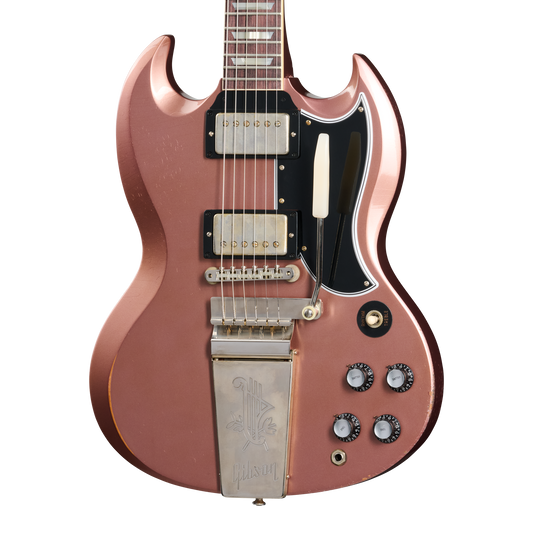
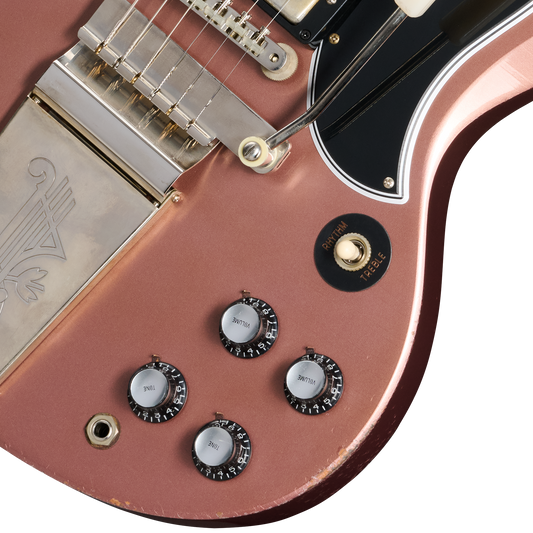
When he’d acquired the guitar, it still had its original Maestro™ Vibrola™, the type with a long plate and a lyre-and-leaves motif. Almost immediately, Eric removed the plate, presumably to reveal more of the fabulous artwork. Soon, though, he disconnected the Vibrola, and into ’68 the arm and mechanism had gone, the frame left as a simple tailpiece. On went a set of Grovers® in place of the original Kluson® tuners.
The Fool SG, as it became known later, served Eric well. He managed to hang on to it, too, avoiding the guitar thieves, and it was his main stage guitar through the remainder of ’67 and on into the summer ’68. He recorded with it extensively, too, notably on a good deal of Disraeli Gears.
During a filmed interview early in ’68, Eric sat on stage at San Francisco’s Winterland with the psychedelic SG. He said that being a guitarist was a useful way to “play out” frustrations, that you could channel pent-up anger by playing aggressively. “Not the way I use it,” he explained, “but that can be done, too, with people like The Who, Pete Townshend.”
 The artwork continues on the back of the neck
The interviewer asked for a demonstration. “What?” Eric said with a grin. “You want me to break the guitar up?” Fortunately not… and Eric proceeded to use the Fool SG to demonstrate for the camera the art of non-destructive musical aggression.
As we now know, Eric would soon leave that wonderful SG behind, along with two more recent faves, his Firebird I and ES-335. As for the painted SG, at some point he may have given it to George Harrison, but it certainly went to Jackie Lomax, a musician friend of George’s from the old Liverpool days, and around 1971 it moved on to Todd Rundgren.
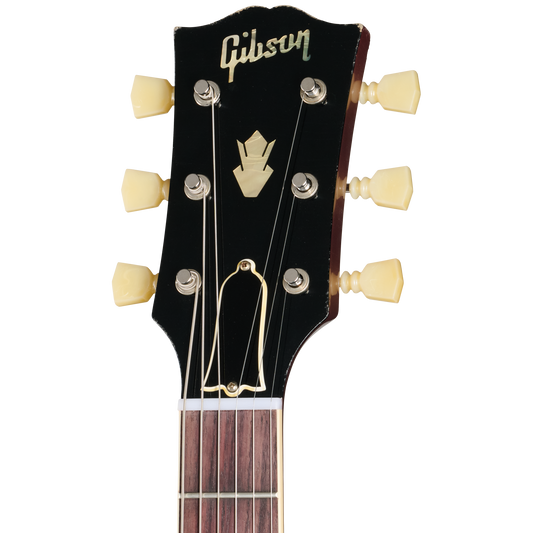
 The Fool’s headstock as it appears today, complete with a brass nut and Grover tuners
Todd replaced the remains of the Vibrola with a stopbar and an incongruous Schaller “harmonica” bridge. He also had the paint on the body restored and sealed, and had part of the neck and the headstock replaced and repainted.
Later, after Rundgren sold it in 2000, the guitar ended up in Jim Irsay’s astonishing collection. Following Irsay’s untimely death last year, the Fool guitar is heading to auction in March as part of Christie’s star-studded Jim Irsay sale, a stunning item among what it calls “a chorus of cultural touchstones”.
 The Fool goes under the hammer in New York on March 12, 2026
Eric Clapton, meanwhile, has shown no signs of returning to his psychedelic past. Marijke Koger, responsible with Simon Posthuma for the original look of the Fool SG, explained that the single thread running through all her paintings is nostalgia for paradise, which she said embodies hope for a better world, a world with more joy, beauty, and peace. No doubt each one of the guitar’s owners, past and present, would endorse that elusive dream.
The Jim Irsay Collection: Hall of Fame auction takes place at Christie’s in New York on March 12 and also includes the 1964 SG formerly owned by George Harrison. Tony Bacon’s latest book is “Electric Blues: T-Bone Walker & The Guitar That Started It All,” available now exclusively at Regent Sounds.