The Gibson Gear Guide returns to Montana to explore four iconic Gibson acoustic guitar body shapes and find out how size, construction, and tonewoods shape their distinctive sounds
To celebrate 100 years of Gibson flat-top acoustic guitars, the Gibson Gear Guide returns to Montana for part two of our journey through Gibson acoustic guitar history. Host Dinesh Lekhraj joins Robi Johns, Senior Product Development Manager, and Don Ruffato, Custom Acoustic Project Manager at Gibson Acoustic, to explore four iconic Gibson body shapes including the L-00, SJ-200™, J-45™, and Hummingbird™, explaining how size, tonewoods, and construction influence the way they respond and sound in very different ways.
 Gibson Custom 1933 L-00 Reissue, Light Aged
What makes the Gibson L-00 so special?
Small-body flat-tops are central to the Gibson story. They first appeared in the Gibson catalog in 1926, marking the beginning of the century of Gibson flat-top acoustic guitars we’re celebrating here in 2026. So what better way to start a brief history of iconic Gibson acoustic guitars than with the L-00?
The Gibson L-00 sits at the smaller-bodied end of the Gibson acoustic spectrum, and its compact, parlor-sized body plays an important role in delivering the focused midrange sound and quick response that blues and country fingerpickers love.
“A small body is a smaller speaker,” Robi Johns explains. “Therefore, the sound is isolated to certain frequencies coming out of that smaller body.” In addition to appealing to soloists, that focused tonality can make a smaller acoustic particularly useful when playing in a band. Rather than occupying a wide frequency range, the L-00 sits naturally in a mix while retaining its distinctive midrange-rich voice.
Small-body Gibson acoustics have a long association with more intimate styles of music. “An L-00 has a very, very nice midrange warmth,” Robi says. “It’s a nice balance of focused sound for mixing into a group and playing intimate music.”
The smaller body also responds quickly to a lighter touch. Don Ruffato describes the L-00 as an ideal fingerstyle guitar, capable of handling subtle playing without the extra push sometimes needed to make a larger body sound louder.
 Gibson SJ-200 60s Original
What makes the Gibson SJ-200 so special?
At the other end of the spectrum from the L-00 is the Gibson SJ-200. Its Super Jumbo body style offers considerably more internal air space than an L-00, creating a broader range of lows, mids, and highs. The model emerged in an era when performers wanted something bigger and more commanding, but its size is only part of the equation.
The maple back and sides construction used on most SJ-200 models helps control the response of that larger body and keeps it snappy when you’re hitting chords. “The big box moves a ton of air, but the maple controls that low end to a point where it gives you a balance,” Don explains. “Maple still gives you that shimmer, that attack, that projection that 200s are known for.” This superior control over your sound is why the SJ-200 has been a familiar sight on stages for generations.
Gibson has produced variations on the Super Jumbo formula using different tonewoods, for the back and sides, including rosewood, but Don describes the traditional maple J-200 sound as the one players associate most closely with the artists who have played the model for decades.
 Gibson Custom 1942 Banner J-45 Reissue, Light Aged
What makes the Gibson J-45 so special?
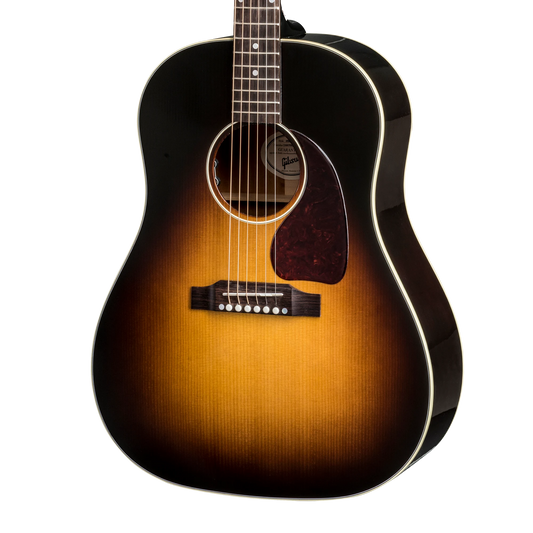
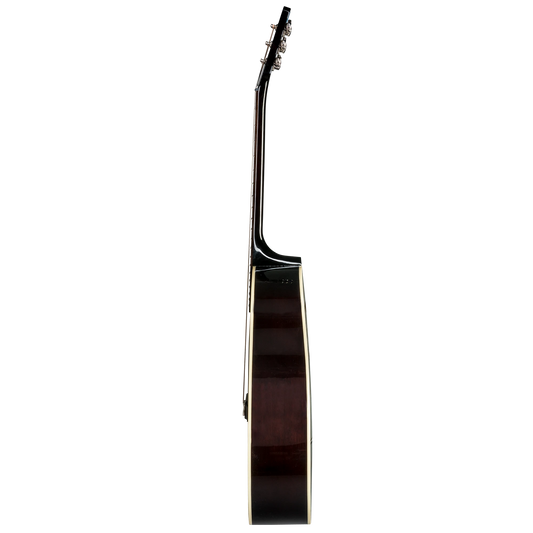
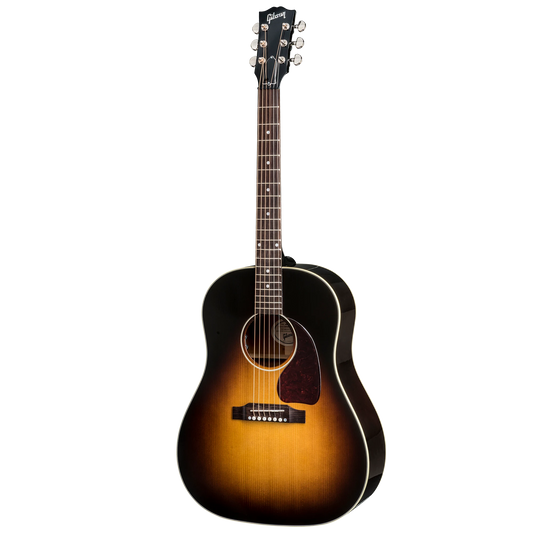
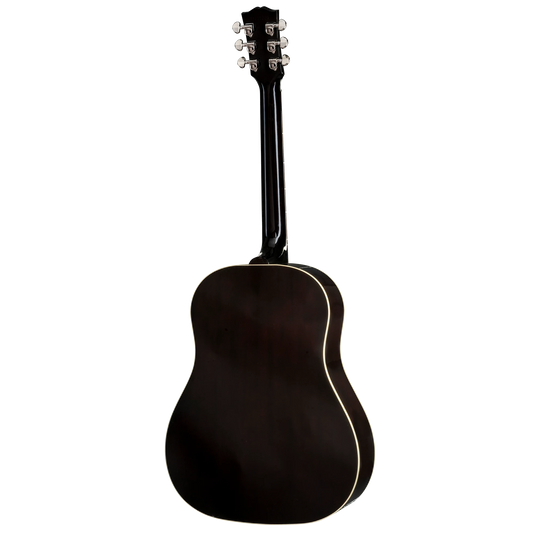
Introduced in 1942, the J-45 has earned its reputation as “The Workhorse” thanks to its use across almost every genre of music. It has a warmth, versatility, and midrange snarl like no other acoustic guitar, and its round-shoulder body shape and time-honored tonewood combination help make it the go-to studio and live guitar for generations of iconic guitarists.
As Dinesh describes it, playing the J-45 feels like being with “an old friend,” with a natural compression when moving between fingerpicking and heavier strumming. Don points to that versatility as one of the reasons the model has endured. “We hit it out of the park in 1942 with the introduction of the J-45,” he says. “The balance, the playability—just the tonality and the warmth you get out of it.”
Don describes the low end as having a growl that players can use expressively, with the instrument changing depending on how it is attacked. “The essence of the Gibson acoustics that I experience is the fact that you can find more expressive sounds out of the instrument [depending on] how you feel,” he explains. “It will respond and make you turn that feeling into a sound.”
For Don, that adaptability is central to the J-45. “No matter what stage of playing you are in technically, no matter what type of music you play, if you’re gonna have one guitar, that is the guitar to have,” he says.
 Gibson Custom 1960 Hummingbird, Ultra Light Aged
What makes the Gibson Hummingbird so special?
The Gibson Hummingbird combines a distinctive tonal character with one of the most recognizable aesthetics in the Gibson acoustic range. In its most iconic incarnation, Heritage Cherry Sunburst finish is paired with the famous hummingbird artwork on the pickguard, a design that Robi explains originated with Gibson artist Hartford Snyder. Hartford loved nature and hand-carved the hummingbird design into a cellulose pickguard. Gibson adopted the artwork, and it became an inseparable part of the model. “The Hummingbird’s special because it was so emotional,” Robi tells Dinesh.
The instrument also delivers a notably balanced response across the lows, mids, and highs thanks to its square-shoulder mahogany and spruce construction. That makes the Hummingbird suitable for everything from fingerstyle playing to forceful strumming, but it develops another characteristic when pushed hard.
Robi explains that the guitar reaches a natural peak in its dynamic range rather than simply becoming louder, comparing the effect to driving the preamp tubes of an amplifier, when the sound begins to compress as it is pushed. “You’re just pounding on this thing, and it’s just stopping,” he says. “And it just sounds great in rock and pop.”
Shop Gibson Hummingbird guitars here.
Four iconic Gibson acoustic guitars, four iconic sounds
The L-00, SJ-200, J-45, and Hummingbird continue to dominate the landscape of popular music, while demonstrating how an acoustic guitar’s body shape and tonewood combination influences its sound. The L-00 offers the focused voice and quick response of a smaller body, while the SJ-200 combines the power of a Super Jumbo with the balance and percussive attack of maple. The J-45 brings warmth, versatility, and an expressive midrange, while the Hummingbird pairs a big, square-shoulder voice with natural compression when pushed hard.
Those differences are also connected to a commitment to preserving the signature construction methods that give Gibson acoustic guitars their individual character, maintained for 100 years. “We’re so dedicated to not changing the internal design and the construction art of what we’re doing inside,” Don affirms.
A century after Gibson flat-top acoustic guitars first appeared in the catalog, key differences in shape, materials, and construction continue to give each model its own distinctive voice, but each design is every inch a Gibson. And for the modern stage, select Gibson acoustic guitars now include the game-changing HiFi DNA™ acoustic pickup system, a new Baggs pickup system designed to bring your guitar’s natural voice to the stage.
Shop Gibson acoustic guitars to find your voice today, and discover more from 100 Years of Gibson Flat-Tops.