From the original P-90 single-coil to high-output modern humbuckers, this complete beginner’s guide to every pickup in the Gibson Pickup Shop explains how to find the best pickups for you
Gibson has been making pickups since 1935, and the two major designs it pioneered—the P-90™ single-coil introduced in 1946 and the humbucker™ perfected by Gibson engineer Seth Lover in 1955—remain the most influential pickups in the history of the electric guitar. But which pickup is best for you, and what are the differences between Gibson pickups?
Today, there are many more options than just two pickup types. If you’ve stood in a guitar store or spent evenings disappearing down an internet rabbit hole trying to figure out the sound differences between a Burstbucker™ and a Custombucker, whether to buy a P-90 Dogear or Soapbar P-90, or exactly why one humbucker™ costs twice as much as another, this is the article for you.
You’re here because you want to know which Gibson pickup from the Gibson Pickup Shop is best for you, and what the differences are between Gibson pickups. This is a complete beginner’s guide to all the current Gibson pickups available today and an explanation of the differences in the way they sound, designed to help you figure out exactly where you sit on the tonal spectrum.
What are the four different Gibson pickup collections?
Today, the Gibson Pickup Shop offers four distinct collections: the Original, Historic, and Modern Collections, plus the Artist Collection, each built around a different vision of tone and a different type of player.
The Original Collection features accurate recreations of Gibson pickup designs that sit comfortably in the middle of the tonal spectrum. Not quite as challenging as unpotted vintage replicas, but not high gain either. These are the all-rounders.
The Historic Collection recreates late-1950s “Patent Applied For“ humbucker tone using period-correct materials like original wire grade, magnets, and unpotted construction. These are as close as you can get to an original vintage PAF pickup today without trawling the secondhand market and paying thousands.
The pickups in the Gibson Modern Collection offer higher-output options with longer sustain, increased output, and greater mix presence for modern performance.
Vintage purists should choose the Historic Collection. Players who want classic Gibson tone with microphonic feedback resistance should choose the Original Collection. Players who need aggressive output and modern performance should gravitate towards the Modern Collection.
A brief history of Gibson pickups
We’ve covered the history of the Gibson pickup in a previous blog, but the story of Gibson pickups begins well before the P-90. In 1935, Gibson introduced its first electromagnetic pickup, known simply as the “bar,” which appeared first on the Gibson Electric Hawaiian before being adopted on the ES-150™, where it became famous in the hands of jazz pioneer Charlie Christian. Before the “Charlie Christian” nickname became widely established, however, the pickup was often associated with guitarist Oscar Moore and was even listed by Gibson in parts literature as the “Oscar Moore” model. By the late 1970s, the Charlie Christian name, most notably his CC initials, had become the more familiar designation, reinforced by the launch of the ES-175CC in 1978.
Throughout the 1940s, Gibson continued to refine its approach, introducing Alnico magnets with individually adjustable pole pieces so you could tweak the response and onboard volume and tone controls. These innovations changed the world of guitars forever and are still used today. Fun fact: Alnico is an alloy consisting primarily of aluminium, nickel, and cobalt, hence AL, Ni, Co.
A brief history of the P-90 pickup
The P-90 single-coil pickup was released in 1946 and is still hugely popular today—check out the video below. Building on his earlier P-13 design, Gibson engineer Walter Fuller created a pickup with a wider, flatter coil than many later single-coil designs, with two sandcast Alnico bar magnets positioned beneath the bobbin, and individually adjustable pole pieces. The result was a pickup with a character unlike anything that had come before: articulate, dynamic, and harmonically rich in a way that has never really been bettered for many styles of playing.
The P-90 quickly became the standard pickup across the Gibson range. When the first Gibson solidbody electric guitar, the legendary Les Paul™, was launched in 1952, it came equipped with twin P-90 single-coils. The pickup appeared on everything from high-end jazz archtops to the original Les Paul Junior and remains in production today with much the same recipe. Rightly so, as it still sounds incredible.
A brief history of the humbucker
By the early 1950s, as amplifiers grew more powerful and stages larger, the 60-cycle hum produced by single-coil pickups was becoming a an issue for some players, making persistent electrical interference harder to ignore. Gibson engineers Walter Fuller and Seth Lover set about solving the issue, and in bucking the hum, changed the sound of popular music forever.
Lover developed a pickup using two coils of wire, wound with opposite magnetic polarities, that canceled electromagnetic interference while producing a sound that was slightly fuller in the midrange and higher in output than a single coil. As a bonus, the twin-coil design added natural compression and an enhanced midrange response that would go on to define the sound of rock ’n’ roll. The humbucking pickup was born.
Why is the Gibson "Patent Applied For" humbucker still the holy grail of guitar pickups?
The results of these hum-canceling experiments were incorporated into a pickup with the part code PU-490, a design for which Gibson filed a patent in 1955. The new humbucker first appeared on the Gibson steel guitars, but the 1957 ES-175 was the first Gibson ES model to use it. That same year, it also became standard on two Les Paul™ models: the Les Paul Goldtop and the three-pickup Les Paul Custom. These original early humbucking pickups (1957-1961) became nicknamed “Patent Applied For” thanks to the decals on the rear of the units, and remain the holy grail of tone.
You’ve probably heard a lot of guitarists talk about the “Patent Applied For” pickup. The patent was officially granted to Gibson in 1959, but Gibson continued using the stickers it had in stock through 1961. Vintage “Patent Applied For” pickups fetch heavy prices on the collector’s market today, but fortunately, this tone can still be achieved thanks to painstaking replicas in the Historic Collection.
What is a P-90 pickup?
The P-90 is a single-coil pickup, meaning it uses one coil of wire wound around a bobbin to generate its signal. What distinguishes it from other single-coil designs is the shape and size of that coil: wider and flatter than those found in an S-style pickup, it produces a sound with considerably more body and midrange weight—something that sits tonally between a traditional bright single-coil and a humbucker but arguably offers more depth than a humbucker when used in the neck position.
The P-90 tone is one of the most expressive and beloved sounds in an electric guitar and has its own fanbase. Deep and warm in the low end, aggressive in the midrange with sparkle and bite in the high frequencies, it responds to players who use their picking hand attack to control tone. Back off and the sound hollows out into something almost acoustic in its clarity. Dig in hard, and it snarls. It is not entirely hum-free—all single-coil designs are susceptible to 60-cycle interference—but for players chasing a combination of articulation and character, there is no better choice.
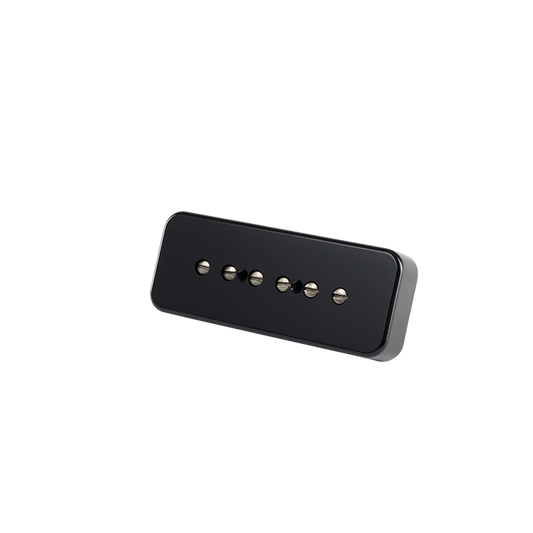
P-90s come in two different physical configurations. The Soapbar P-90 gets its name, unsurprisingly, from the shape of its pickup covers. It is height-adjustable, and is designed for guitars with routed pickup cavities like a Les Paul Standard or Custom.
The Dogear P-90 is recognizable because it looks like it has ears where the screws directly screw into the top of the guitar, like on a Junior or ES-330. The electronics are essentially identical, but the way they’re mounted to the body can have a subtle influence on tone—as can cover material. You can raise the pole-pieces of each, but on a Soapbar, you can drop or raise the entire pickup. The height of a Dogear is fixed.
 The "Orphanage Burst" 1959 Gibson Les Paul Standard featuring “Patent Applied For” humbuckers
What is a humbucker pickup?
A humbucker gets its name because it literally bucks hum. It does this by using two coils, wound in opposite directions with opposite magnetic polarities. That configuration not only cancels the hum that you get from single-coil pickups, but also produces a tone that sounds fuller and warmer. The twin-coil design introduces natural, musical compression and enhances low and midrange frequencies.
Compared to a P-90, a humbucker sounds smoother and more rounded overall, and is often slightly easier to mix in a live band context. Where a P-90 offers bite, clarity, huge dynamic range and a raunchy midrange character, a humbucker is typically smoother and more compressed, with more controlled bass. There’s no “better” pickup type—it all comes down to personal choice and musical context. Most guitarists have instruments with both pickup types in their arsenal.
Pickup magnets explained
In this article, you’re going to read plenty about pickup magnet types. Here is a reference guide with the typical pickup magnets explained (order of strength from weakest to strongest):
- Alnico 3: The warmest of the Alnico varieties, clear, articulate, and harmonically open.
- Alnico 2: Low output, warm, sweet, and particularly sensitive to picking dynamics.
- Alnico 4: Sits between Alnico 2 and Alnico 5 in character, offering a balance of warmth and presence. Used in the 1959 Humbucker Collector's Edition Series 1.
- Alnico 5: The strongest of the Alnico group. Brighter, more present, and more aggressive in character.
- Ceramic: Higher output than any Alnico variety, defined, aggressive, and built for high-gain applications.
- Neodymium: A modern rare-earth magnet used in the P-90 DC variants to deliver classic P-90 character in a hum-canceling design.
- Ceramic and Alnico 2 combined: The exclusive configuration used in the Tony Iommi Signature Humbucker, pairing the output of ceramic magnets with the warmth and sensitivity of Alnico 2 for thunderous tone with crystal clarity—even under full distortion.
Gibson Pickup Comparison Guide
| Pickup | Collection | Magnet | Key Characteristics |
|---|---|---|---|
| P-90 Dogear & Soapbar | Original | Alnico 5 | Articulate, dynamic single-coil tone. Wax potted. Great for blues, rock, jazz, and punk. |
| P-90 Dogear & Soapbar Underwound | Original | Alnico 3 | Less output than the standard P-90, bright and clear at any volume. Wax potted. Great for the rhythm position. |
| ’57 Classic | Original | Alnico 2 | PAF-inspired. Balanced coils for a smooth, creamy tone. Wax potted. Great for classic rock, blues, and jazz. |
| ’57 Classic Plus | Original | Alnico 2 | Overwound for more output and warmth. Wax potted. Great for the bridge position paired with the ’57 Classic. |
| ’57 Classic Underwound | Original | Alnico 2 | Fewer windings for less output and a brighter tone. Wax potted. Great for the rhythm position. |
| ’57 Classic Quick Connect | Original | Alnico 2 | PAF vibe with solderless installation and coil-splitting capability. Wax potted. Great for players who want easy fitting and tonal flexibility. |
| 60s Burstbucker | Original | Alnico 5 | Unbalanced coil windings for an airy, full tone with enhanced highs when overdriven. Unpotted. Great for classic and early hard rock. |
| 70s Tribute | Original | Alnico 5 | Higher output with warmth, punch, and attitude. Wax potted. Great for hard rock and drop tunings. |
| Original Mini-Humbucker | Original | Alnico 2 | Compact humbucker that fits a P-90 slot. Bright and focused with full humbucker warmth. Wax potted. Great for the neck position. |
| Firebird Reissue | Original | Alnico 5 | Sits between a single coil and a humbucker. Bright highs with tight, full lows. Wax potted. Great for clean tones and vintage rock. |
| Firebird Reissue Plus | Original | Alnico 5 | Wound hotter for a thicker, fuller voice. Wax potted. Great for the bridge position paired with the Firebird Reissue. |
| T-Type | Original | Alnico 5 | Homage to the T-Top humbuckers of 1966 to 1979. Articulate and clear with controlled lows. Wax potted. Great for clean tones and light overdrive. |
| Burstbucker Type 1 | Original | Alnico 2 | Underwound for lower output and a warm, sweet vintage voice. Great for the neck position. |
| Burstbucker Type 2 | Original | Alnico 2 | Medium output with a warm, traditional vintage character. Great for any position. |
| Burstbucker Type 3 | Original | Alnico 2 | Overwound for more drive and attack. Great for the bridge position. |
| Burstbucker Pro | Original | Alnico 5 | Fatter, meatier tone with more drive and attack than the Burstbucker Type 3. Great for players who want more aggression from a vintage-voiced pickup. |
| 1968 T-Top Reissue | Historic | Alnico 5 | Period-correct T-Top replica with two-conductor wiring and matched coils, unlike the asymmetric windings used elsewhere in the Historic collection. Unpotted. Brighter, tighter, and more aggressive than a late 1950s PAF. Great for classic and hard rock. |
| 1959 Humbucker Collector’s Edition Series 1 | Historic | Alnico 4 | The most accurate PAF recreation ever made. Unbalanced coils, 42 AWG plain enamel wire, unpotted. Sweet, woody, loud, and present. Limited to 1,000 serialized sets. |
| 1959 Humbucker Collector’s Edition Series 2 | Historic | Alnico 2 | First Murphy Lab-aged release in the range. Unbalanced coils, 42 AWG plain enamel wire, unpotted. Limited to 1,000 serialized sets. |
| 1959 Humbucker Collector’s Edition Series 3 | Historic | Alnico 3 | Most heavily aged of the three series, with every metal component aged by the Murphy Lab team. Unbalanced coils, unpotted. Limited to 1,000 serialized sets. |
| Custombucker | Historic | Alnico 3 | Standard on Custom Shop Historic Reissues. Unbalanced coils, 42 AWG wire, unpotted. Warm, sweet, and sparkling clean. Great for vintage PAF tone at an accessible price. |
| Custombucker Plus | Historic | Alnico 3 | Extra windings for slightly higher output. Great for the bridge position paired with a standard Custombucker. |
| Custombucker Underwound | Historic | Alnico 3 | Fewer windings for an open, airy character with clean harmonics. Great for the neck position. |
| 490R Modern Classic | Modern | Alnico 2 | PAF-inspired with four-conductor wiring for coil splitting. Wax potted. Smooth, lush, and articulate. Great for the rhythm position. |
| 490T Modern Classic | Modern | Alnico 2 | PAF-inspired with four-conductor wiring for coil splitting. Wax potted. Slightly higher resistance for more presence and cut. Great for the bridge position. |
| 498T Hot Alnico | Modern | Alnico 5 | High output with emphasis on upper midrange for enhanced crunch and sustain. Can be wired for coil split. Wax potted. Great for hard rock and metal. |
| 496R Hot Ceramic | Modern | Ceramic | Incredible sustain and cutting power with no muddiness. Can be wired for coil split. Wax potted. Great for hard rock and metal. |
| 500T Super Ceramic | Modern | Multi-Ceramic | The highest-output pickup in the Gibson range. Enhanced lows and crystal clear highs. Can be wired for coil split. Wax potted. Great for high-gain hard rock. |
| Dirty Fingers | Modern | 3x Ceramic | Overwound with balanced coils for all-out maximum output. Can be wired for coil split. Wax potted. Great for high-gain 70s-inspired tones. |
| Dirty Fingers SM | Modern | Ceramic 8 | Focused, punchier midrange with high-gain attitude. Can be wired for coil split. Wax potted. Great for modern and classic rock players who want drive with more clarity. |
| Greenybucker Set | Artist | Alnico 2 (Unpolished) | Asymmetric coil windings and reverse magnetic polarity for the signature out-of-phase middle position tone of the "Greeny" Les Paul. Great for vintage humbucker tone with a unique vocal middle position. |
| Tony Iommi Signature | Artist | Ceramic & Alnico 2 | Full-shred tone, exceptional sustain, and crystal clarity under full distortion. Can be wired for coil split. Wax potted and epoxied. Great for metal. |
Gibson Pickup Shop: Original Collection
The Gibson Pickup Shop Original Collection is where you’ll find designs invented by Gibson. These pickups balance the vintage character guitarists look for, but are not quite as challenging as an upotted replica of a “Patent Applied For” pickup. Think of them as all-rounders somewhere in between vintage and modern sounds, without pushing into high-gain territory. These pickups have appeared on decades of modern hit records across virtually every genre.
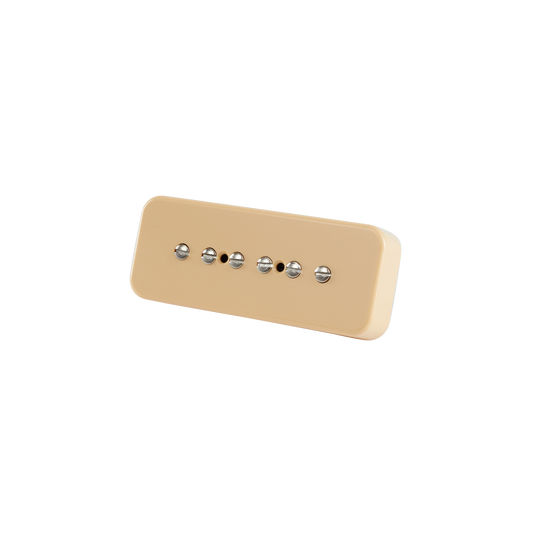
 Gibson P-90 Soapbar Pickup in Cream
Dogear and Soapbar P-90s
In many ways, the Gibson P-90 Dogear and Gibson P-90 Soapbar are where this whole story starts. They are direct descendants of Walter Fuller’s 1946 design, and they sound every bit as vital today as they did then. These pickups are genuinely at home in blues, rock, jazz, and punk context, and they have proven that versatility on recordings stretching back eight decades. If you have never played a guitar with a P-90, you really should try one.
You have several choices here. The Gibson P-90 Soapbar Pickup and Gibson P-90 Dogear Pickup lead the pack, but there’s also the Gibson P-90 Soapbar Underwound Pickup and Gibson P-90 Dogear Underwound Pickup. The difference here is the Underwound versions use Alnico 3 magnets and the standard versions use Alnico 5. The underwound versions deliver a bit less output than a standard P-90 but with a bright tone that remains clear at any volume. Both are fully wax potted, so there’s less chance of unwanted microphonic feedback, but if you want hotter versions, go for the standard.
 Gibson '57 Classic Pickup in Nickel
’57 Classic
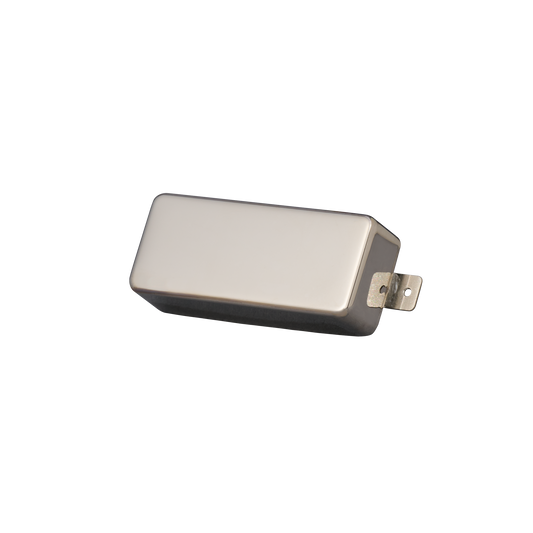
The Gibson ’57 Classic™ humbucker is the benchmark “Patent Applied For”-inspired pickup in the Original Collection. The key here is that you have Alnico 2 magnets, which are the same spec as the original “Patent Applied For” pickups. The ’57 Classic is wax-potted to reduce unwanted feedback, and they use balanced coils for a smoother, creamier tone.
Also available: The ’57 Classic Plus is overwound for more output and added warmth, and is designed to pair naturally with the standard ’57 Classic as a bridge and neck set. The ’57 Classic/’57 Classic Plus Set makes that pairing easy. The ’57 Classic Underwound uses fewer windings and delivers slightly less output with a brighter overall tone, ideal for the rhythm position. The ’57 Classic Quick Connect features solderless installation and coil-splitting capability.
 Gibson 60s Burstbucker Pickup in Nickel
60s Burstbucker
On the shop floor of the original Gibson plant in Kalamazoo, Michigan, the earliest “Patent Applied For” humbuckers were wound using imprecise machines, which meant the pickups of that era had varying degrees of output and tone. That inconsistency turned out to be part of the magic that collectors search for. The Gibson 60s Burstbucker recreates the historically unbalanced coil windings and uses Alnico 5 magnets to produce an airy, full tone, and when overdriven, achieves a magical distortion with the slightly enhanced highs. They’re unpotted and equipped with vintage braided two-conductor wiring, so they’re extremely accurate as to the sound of the 60s era pickups.
 Gibson 70s Tribute Pickup, Rhythm in Double Black
70s Tribute
By the mid-1970s, a new breed of hard-rocking players was emerging on the scene, and Gibson responded. The 70s Tribute is a nod to the hotter pickups Gibson released to meet that moment, built with more windings, strong Alnico 5 magnets, and wax potting to eliminate microphonic feedback at high volume levels. With lots of attitude, warmth, and punch, it hits the front end of your amp with more output and signal level, so it can be driven into overdrive more easily, making it an excellent choice for drop tunings and hard rock. If you’re into heavier music, get this. Available as the Treble version and also the Rhythm version.
 Gibson Original Mini-Humbucker Pickup in Chrome
Original Mini-Humbucker
In the late 1950s, Epiphone engineers created a P-90-sized pickup with no hum, a smaller, more compact humbucker that can fit into the routing slot of a P-90. First made available in several Gibson-made Epiphone models before appearing on the Les Paul Deluxe in 1969, this vintage replica nails the authentic look, feel, and construction, from the cream-colored plastic mounting ring and coated enamel-like wire to its maple spacers and vintage braided lead wire. An Alnico 2 bar magnet, two-conductor wiring, and wax potting produce a bright and focused output while retaining the warmth and performance of a full-sized Gibson humbucker. Available in Rhythm and Treble versions.
Fun fact: Contrary to popular belief, Mini-Humbucker is not the same as a Firebird pickup. Though they look similar, the Firebird pickup is a different design entirely with its own distinct tonal character. Which brings me to my next pickup…
 Gibson Firebird Reissue Pickup in Nickel
Firebird Reissue and Firebird Reissue Plus
Firebird™ pickups have had a cult following since the model first hit the scene in 1963, and now, for the first time, they are available as an aftermarket pickup. The Gibson Firebird Reissue Pickup’s tone sits somewhere between a humbucker and a single coil, delivering bright and clear sounds in the highs, with the full, tight lows you expect from a Gibson humbucker. The Firebird Reissue is wound to vintage 1960s specs, uses Alnico 5 magnets, and is wax-potted to keep unwanted feedback at bay at higher volumes.
Want a little more heat? The Firebird Reissue Plus is wound hotter for a slightly thicker, fuller version of the same voice and pairs perfectly as a bridge pickup with a standard Firebird Reissue in the neck position.
 Gibson T-Type Pickup, Treble in Nickel
T-Type
The Gibson T-Type humbucker pays homage to the T-Top humbuckers produced from 1966 to 1979, using Alnico 5 magnets and balanced coil windings to deliver a consistent, player-friendly version of that era’s sonic character. The sound of a T-Type humbucker is articulate and clear with controlled lows and a clarity that suits clean tones and light overdrive particularly well.
Also worth considering: The 1968 T-Top Reissue in the Historic Collection for a more period-correct, unpotted take on the same pickup era, including the original two-conductor wiring.
 Gibson Burstbucker Type 1 Pickup in Nickel
Burstbucker Type 1, Type 2, Type 3, and Burstbucker Pro
You might be wondering how these differ from the 60s Burstbucker. The key distinction is that the 60s Burstbucker uses Alnico 5 magnets for a brighter, more assertive character, while the Burstbucker Type 1, 2, and 3 all use Alnico 2 magnets for a warmer, sweeter, and more traditional vintage voice. Both share the unbalanced coil-winding approach, but they land in noticeably different tonal territories.
So what is the difference between the Burstbucker Type 1, Type 2, Type 3, and the Burstbucker Pro?
The Burstbucker Type 1 is slightly underwound for lower output and works beautifully in the neck position.
The Burstbucker Type 2 sits in the middle with medium output and is versatile enough for any position.
The Burstbucker Type 3 is overwound and hotter, typically the go-to for the bridge position when you want more drive and attack.
The Burstbucker Pro takes things in a slightly different, more aggressive direction. It swaps the Alnico 2 magnets for Alnico 5 magnets, delivering a fatter, meatier tone with more drive and attack than the Burstbucker 3.
Gibson Pickup Shop: Historic Collection
The Gibson Historic Collection Pickups is where Gibson gets as close as possible to the original “Patent Applied For” sound. This is where the focus is purely on the sought-after classic tones of the Gibson Golden Era, delivering pure vintage voice at a fraction of the cost of hunting down the originals on the second-hand market.
 Gibson 1968 T-Top Reissue in Double Vintage White
1968 T-Top Reissue
One of the most influential humbucker voices in rock history has just returned. The Gibson 1968 T-Top Reissue brings back the unmistakable look and sound of the original T-Top pickups produced from 1966 to 1979, with era-correct details.
Available in Double Black and Vintage White bobbins, they stay true to the originals with Alnico 5 magnets, period-correct winding specs, and two-conductor wiring, and are left unpotted just like the originals. Unlike the asymmetric windings used elsewhere in the Historic Collection, the T-Top's coils are matched, just as they mostly were historically.
 Gibson 1959 Humbucker, Collector’s Edition, Series 1
1959 Humbucker Collector’s Edition
The original “Patent Applied For” humbuckers from the 1950s are considered the holy grail of pickup tone, and the 1959 Humbucker Collector’s Edition is the most accurate recreation of them ever made. Developed using 3D scanning, scientific analysis, and reverse engineering of original late-1950s examples, alongside specifications from the Gibson archives, these sets are accurate right down to the tool marks on the baseplates. Each series is limited to 1,000 individually serialized sets, packaged in a Lifton™ presentation case with 1959-style numbering, all three feature unbalanced coils, 42 AWG plain enamel wire, and are left unpotted. The tone across all three is sweet, woody, loud, and present, with subtle variations between series depending on magnet type.
So what is the difference between the three series? It comes down to magnets, bobbins, and aging.
Series 1 uses Alnico 4 roughcast magnets with double Vintage White butyrate bobbins and True Historic nickel covers.
Series 2 is the first aftermarket Murphy Lab-aged release of the range. It uses Alnico 2 roughcast magnets with Zebra butyrate bobbins, Vintage White on the slug sides and black on the screw sides, with Murphy Lab-aged covers and cream M69 mounting rings.
Series 3 goes furthest with the aging, with every metal component, including covers, baseplates, screws, and springs, masterfully aged by the Murphy Lab team. Alnico 3 roughcast magnets and double Vintage White butyrate bobbins are paired with yellowed cream M69 mounting rings. It’s like grabbing a vintage set from a 1959 Les Paul.
 Gibson Custombucker Set in Nickel
Custombucker
The Gibson Custombucker is the standard pickup on the Gibson Custom Shop’s Historic Reissue guitars, handcrafted in Nashville, Tennessee. They’re an accurate replication of the original “Patent Applied For” sound with Alnico 3 magnets, 42 AWG wire, unbalanced coils, and are left unpotted, exactly as the originals were. Warm, sweet, and sparkling clean, with a harmonic richness and extended high-frequency response that you really need to hear to appreciate.
If you want the vintage humbucker sound at an accessible price, this is what you need.
The Custombucker Plus adds extra windings for slightly higher output, ideal for the bridge position paired with a standard Custombucker at the neck. The Custombucker Underwound goes the other way, with fewer windings for an even more open and airy character with beautiful, clean harmonics.
Gibson Pickup Shop: Modern Collection
The Gibson Modern Pickup Collection is built for players who need more from their pickups! The Gibson Modern Collection series still delivers classic Gibson tones, but these models have hotter output, ideal for rock and more aggressive styles of music. These models all feature four-conductor wiring configurations for series, parallel, or split-coil options, so you have an incredible number of options. However, there are some key differences between each of these Gibson pickups below:
 Gibson 490R Modern Classic Pickup, Rhythm in Gold
490R Modern Classic
The Gibson 490R Modern Classic pickup is a rhythm-position humbucker that takes the traditional characteristics of the original “Patent Applied For” pickups and adds two key updates for the modern guitarist. First of all, they have four-conductor wiring, which lets you connect to any push/pull knob for coil splitting, turning it into a single coil at the push of a pot. Second, wax potting eliminates any air space and keeps microphonic feedback in check at maximum volume, which is super handy when you’re shredding. The result is a smooth, lush, and articulate pickup with a slight increase in upper-midrange response compared to a vintage-spec humbucker. The ideal pairing is with the 490T in the treble position, or the 498T when you need more output.
 Gibson 490T Modern Classic Pickup, Treble in Chrome
490T Modern Classic
The 490T is the treble-position companion to the 490R, sharing the same “Patent Applied For”-inspired foundation, four-conductor wiring for coil splitting, and wax potting for feedback-free performance at high volumes. Where the 490R sits in the rhythm position, delivering warmth and articulation, the 490T brings that same modern classic character to the bridge, with a slightly higher DC resistance of 8.2k for a touch more presence and cut. Available individually or as part of the 490R/498T Set.
 Gibson 498T Hot Alnico Pickup, Treble, Zebra
498T Hot Alnico
You’ll want the 498T if you’re a metal player. It’s a high-output version of the 490T, combining the more powerful response of an Alnico 5 magnet with additional balanced windings on each coil, putting the emphasis firmly on the upper midrange frequencies for enhanced crunch and sustain. It is perfect for hard rock and metal. The pole pieces are also aligned a little further apart than standard to accommodate bridge string spacing, which aids in producing powerful leads and thick rhythm parts without sacrificing single-note definition. Fully wax-potted to prevent unwanted feedback, the four-conductor wiring for series, parallel, or split-coil operation provides tonal options. It pairs naturally with the 490R in the neck position and is available individually or as part of a set.
 496R Hot Ceramic Pickup, Rhythm, Double Black
496R Hot Ceramic
When a pickup with an Alnico is not hot enough for you, the 496R Hot Ceramic steps in with a ceramic magnet. Using a powerful ceramic magnet for incredible sustain and cutting power, it adds more highs and increased definition without any muddiness. Leads have a biting, bluesy edge with a notable increase in musical harmonics, making it an excellent choice for hard rock and metal players, or those who just want notes to resonate for days. Again, it features four-conductor wiring for series, parallel, or split-coil operation and is fully wax potted. Available individually or as part of the 496R/500T Set with the 500T Super Ceramic.
 500T Super Ceramic Pickup, Treble in Double Black
500T Super Ceramic
You’ve reached the final boss of analog pickups in terms of output. If it is a no-holds-barred, in-your-face hard rock tone you are after, the 500T Super Ceramic is the highest-output pickup in the Gibson range, and your new best friend. Built around a powerful multi-ceramic magnet structure, it’s an absolute monster of high-output potential that can scream or growl, never losing its rich combination of enhanced lows and crystal clear highs. It also features four-conductor wiring for series, parallel, or split-coil operation and is fully wax-potted to eliminate any chance of microphonic feedback when you’re melting faces on stage. Did I mention how loud this thing is, yet? Available individually or as part of the 496R/500T Set with the 496R Hot Ceramic.
 Dirty Fingers Onyx & Dirty Fingers SM Onyx
Dirty Fingers and Dirty Fingers SM
The Gibson Dirty Fingers humbucker is an accurate replica of the famous super-hot humbucker introduced by Gibson in the 1970s. Originally manufactured with three powerful ceramic magnets (like three fingers), it is overwound yet features balanced coils, making it quite high-gain.
There are two versions available, and the key difference lies in the magnet configuration and tonal character. The standard Dirty Fingers uses three powerful ceramic magnets for all-out, in-your-face maximum output. The Dirty Fingers SM (single magnet) uses a single Ceramic 8 magnet for a more focused, punchier midrange character without compromising the pickup’s fundamental attitude, making it an excellent choice for modern and classic rock players who want serious drive with a little more clarity in their lead tones. Both are fully wax potted, with four-conductor wiring, and both are also available in an Onyx finish featuring double black bobbins, black screws, and a matte black logo for players who want a full blackout aesthetic to match the tone. If you want high gain, but with 70s-inspired sounds, go here.
Artist Collection
Finally, we have the Gibson Artist Collection pickups, made in collaboration with your favorite iconic guitarists.
 Gibson Aged Greenybucker Pickup Set
Greenybucker set
Some guitars take on a life beyond their original owners, and Greeny is one of them. The 1959 Les Paul Standard, first owned by Peter Green, later by Gary Moore, and now in the hands of Kirk Hammett, has a very unique sound thanks to its out-of-phase placement. You can now get that exact sound! Developed with input from Kirk Hammett himself and with specifications taken directly from the actual pickups on that world-renowned guitar, the Greenybucker Set features asymmetric coil windings, unpolished Alnico 2 magnets, and reverse magnetic polarity on the rhythm pickup for that signature out-of-phase middle position tone. In individual positions, it sounds like a beautifully voiced vintage humbucker. Hit the middle position, and you get that famous hollow, vocal quality.
 Gibson Tony Iommi Signature Humbucker
Tony Iommi Signature Humbucker
We wouldn’t have metal with Iommi and his Gibson SG™. So it’s only right that we brought his first-ever Gibson signature pickup back. Developed with Iommi in the late 1990s and back in production, the Tony Iommi Signature Humbucker features an exclusive configuration of powerful ceramic and Alnico 2 magnets with special windings that deliver the incredible tone and sustain that made his sound instantly recognizable. Full-shred tone, exceptional sustain, and crystal clarity even under full distortion, fully wax-potted and epoxied for absolute feedback protection, with four-conductor wiring for series, parallel, and split-coil operation, if needed. If you want to sound like Tony Iommi, start here!
Which Gibson pickup is right for you?
There is no wrong choice in the Gibson Pickup Shop, but there is almost definitely a best Gibson pickup for your sound and style of playing, maybe even more than one! If you are chasing the most accurate recreation of the original late-1950s humbucker sound, the Historic Collection is where to start, with the 1959 Humbucker Collector’s Edition and Custombucker getting you as close as possible without trawling the secondhand market.
If you love that classic Gibson sound that your guitar heroes have, but need something designed for the modern-day amplifiers and stages of the world, the Original Collection has you covered, from the iconic P-90 and ’57 Classic pickups through to the Burstbucker range. And if you want to crank the gain, push your amp into overdrive, and melt the paint off the walls, or melt faces on stage, the Modern Collection is what you need, from the 490 and 498 pairing all the way up to the ceramic-powered 500T and Dirty Fingers. But whatever era of tone you are chasing, Gibson has been getting this right for nine decades, and we can safely say there’s a best Gibson pickup here for you.
Compare Gibson pickups and shop the full range at the Gibson Pickup Shop.