Which Les Paul Junior is right for you in 2026? What are the different types of Gibson and Epiphone Les Paul Junior guitars? Read our complete Les Paul Junior comparison and buyer’s guide
The Gibson Les Paul™ Junior is one of the most iconic electric solidbody guitars in the world, and a favorite among the Les Paul lineup of guitarists looking for a no-frills rock machine. Although it garnered a fanbase for its stripped-back design, lightweight construction, and the incredible growl of its single P-90 pickup, don’t be fooled—you’d be forgiven for thinking the Junior is not as versatile as a two-humbucker™ Les Paul Standard or Custom, but Juniors offer an incredible range of tones once you know how to make the most of their deceptively simple controls.
Introduced as a single-cutaway slab-body student model in 1954, by late 1958 the Les Paul Junior had transitioned to a symmetrical double-cutaway design offering superior upper-fret access. Then, in 1961, the Junior made the switch to the thinner and more contoured body style that would eventually become known as the SG.
Accessibly priced even today, the Les Paul Junior has been used by a wide array of players in many genres. Thanks to their ease of use, pioneering proto-punks Sylvain Sylvain and Johnny Thunders from the New York Dolls referred to Juniors as “automatic guitars,” while subsequent carriers of the punk-rock torch like Mick Jones of The Clash and Billie Joe Armstrong of Green Day were similarly hip to the Junior’s considerable charms as a raucous rhythm machine.
It’s not all about punk, though—from Leslie West’s Mountain-sized tones at Woodstock to the Southern fried rock sounds of Blackberry Smoke frontman Charlie Starr, not to mention the imperious rock ’n’ roll swagger of Keith Richards, for pretty much any brand of rock or Americana music you can think of, the Les Paul Junior is where it’s at.
So you’re here because you want to know what makes the Les Paul Junior so good, or you’re wondering what the best Gibson or Epiphone Les Paul Junior model is for you. Or you might be wondering what the main differences are between a Les Paul Junior and a Les Paul Standard. Whichever way you slice it, this Les Paul Junior buyer’s guide will help you decide which Les Paul Junior is the best for you. We’ve already compared every type of Gibson Les Paul currently available, and compared every Epiphone Les Paul too. Now it’s time to focus on the Junior—read on to find out more.
A brief history of the Gibson Les Paul Junior
Introduced in 1954, the Gibson Les Paul Junior was designed as a no-frills student solidbody electric guitar, with the same single-cutaway silhouette as the Les Paul Goldtop and Custom but a reduced array of features to make it both more affordable and easier to make. It featured an uncontoured slab mahogany body, a single P-90 pickup in the bridge position, and a wraparound bridge. These core specifications are mirrored in many Junior models today and there’s something about the immediacy of the wraparound bridge that still speaks to players looking for a dynamic, touch-sensitive response with sustain for days.
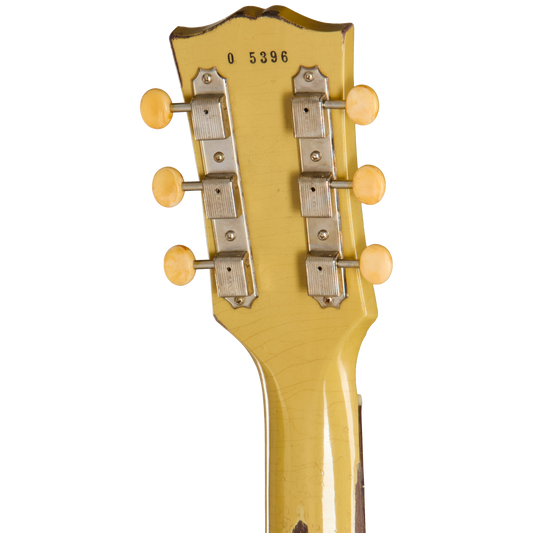
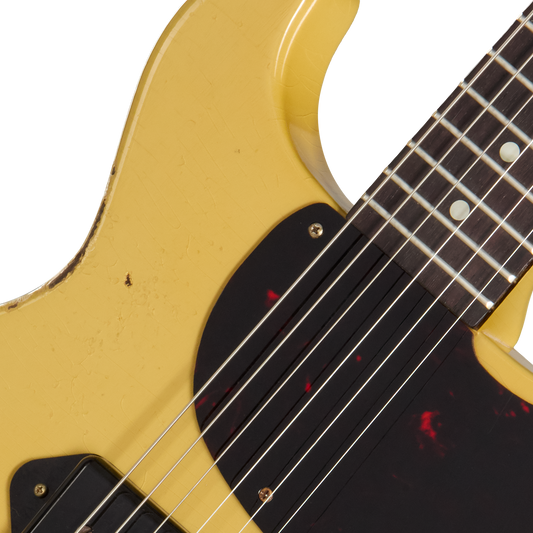
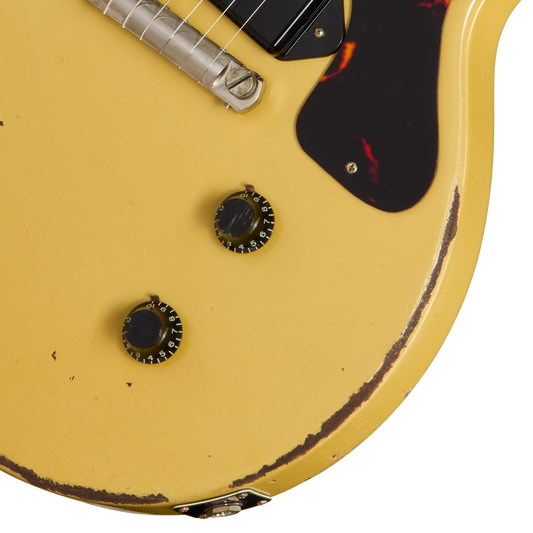
As we’ve already mentioned, there were few key changes to the Les Paul Junior design during its first seven years of production. 1955 saw the arrival of the Les Paul TV Model—essentially the same as a Les Paul Junior but featuring a limed mahogany TV Yellow finish and “Les Paul TV Model” silkscreened on the headstock. The internet is full of speculation about what the “TV” in TV Yellow refers to, but it is widely thought that the finish was designed to look better on black and white television broadcasts than pure white, which could cause video artifacts.
 The TV Model and Junior side by side in an original 1950s catalog
Some early Juniors with maple bodies are known to exist, as well as special order 3/4-sized models, but for the most part, specifications didn’t deviate until early 1956, when bridge studs were lengthened and the P-90 pickup was moved further away from the bridge to alleviate problems with lean on some earlier models under string tension. The net result wasn’t only a more stable instrument but also a slightly fuller sound with the pickup closer to the neck. Then, in 1957, the Junior really got into its groove when Gibson transitioned from Alnico 3 to Alnico 5 magnets in its P-90 pickups, delivering a slightly hotter and more aggressive tonality.
As previously mentioned, the second half of 1958 would see the biggest change to the Junior so far, with a shift to a new double-cutaway body style, a slimmer neck profile, and the introduction of the Cherry finish. 1961 would see a further significant evolution with the adoption of what later became known as the Gibson SG body shape. Anatomically, it was a very different guitar and these early sixties Juniors have a voice of their own that many players love for slide guitar playing. The headstock still carried Les Paul’s name until 1963, when it was officially rechristened the Gibson SG Junior. The Les Paul Junior wouldn’t make a comeback in the Gibson catalog until the mid-1980s. Happily, these days, there are myriad Les Paul Junior models to choose from. We’ll take a look at some of those shortly.
What does the Les Paul Junior sound like?
Guitarists love the sound and the raw energy of the Les Paul Junior. The single P-90 pickup delivers a tone that’s very different to either a humbucker or other types of single coil, with a strong midrange, plenty of depth and bite, and the ability to go from jangly, hollow clean tones to hard rocking with a twist of the volume control.
If you’re worried that you’ll miss having a neck pickup to switch to, you’ll be happy to learn that rolling back the tone control and playing up near the end of the fretboard—especially with fingers rather than a pick—delivers a rich array of warm and full-bodied sounds. You might even start to wonder if a single pickup electric guitar is all you need.
Who plays a Les Paul Junior?
Although the Les Paul Junior was designed for students and beginners, over the decades, it’s been embraced by some of the most recognisable names in music. Famous Junior players have included Keith Richards, Sylvain Sylvain, Johnny Thunders, John Lennon, Keith Urban, Rory Gallagher, Leslie West, Billie Joe Armstrong, Rivers Cuomo, Jared James Nichols, Jane Wiedlin of The Go-Go’s, Charlie Starr, Slash, Paul Westerberg of The Replacements, and many more. You’ll hear the Junior across a wide array of genres from blues to indie and punk to funk, but its incredible dynamic response and stripped-down attitude make the Les Paul Junior a favorite for rock guitarists looking for big, uncompromising rhythm sounds and incisive lead tones.
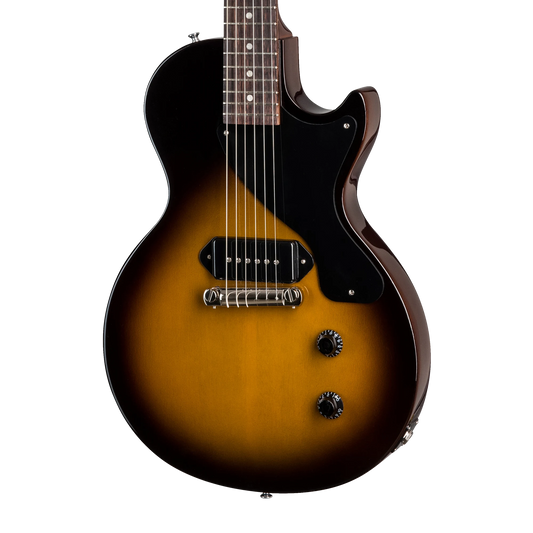
 The Gibson Les Paul Junior Faded in Tobacco Burst Satin
Is the Les Paul Junior versatile?
Yes, it really is. Over time, Les Paul Junior players realised that the lack of a neck pickup wasn’t a limitation—it was part of the appeal. Some experts point to the lack of a neck pickup reducing magnetic string pull, which translates to increased sustain compared to a twin-pickup Les Paul Special with otherwise very similar construction. There’s also no neck pickup cavity, so Juniors have more wood under the strings. Whether it’s one particular aspect or the sum total of the whole package, there’s little doubt that the Les Paul Junior offers an addictive and hugely expressive playing experience, with a wide range of tones under your fingers.
What are the different types of Les Paul Junior?
The different types of Les Paul Junior models available today span both the Epiphone and Gibson catalogs, ranging from accessible models for beginners and younger players to historically accurate vintage reissues from Gibson Custom. While they all follow the same core formula with the mahogany body, wraparound bridge, and single pickup, the main differences are the single or double cutaway body style and how closely they stick to vintage specs. Let’s take a look at the models and see how they compare.
 The Epiphone Les Paul Junior in Vintage Sunburst
Epiphone Les Paul Junior
The Epiphone Les Paul Junior stays faithful to the essence of the original 1954 design. Built around a slab mahogany body, single Epiphone P-90 PRO Dogear pickup, and wraparound bridge, it delivers the Les Paul Junior experience at a really accessible price point. This is one of the best Les Paul Junior guitars for beginners as well as those who want a gig-ready workhorse when they’re just starting out.
 The Epiphone Les Paul Junior Double Cut in Ebony
Epiphone Les Paul Junior Double Cut
The Epiphone Les Paul Junior Double Cut from the Epiphone Inspired By Gibson collection introduces the double-cutaway body first seen in 1958. It has the same stripped-back approach with the slab mahogany body, single P-90, and wraparound bridge, but offers improved upper-fret access, giving you a little more freedom.
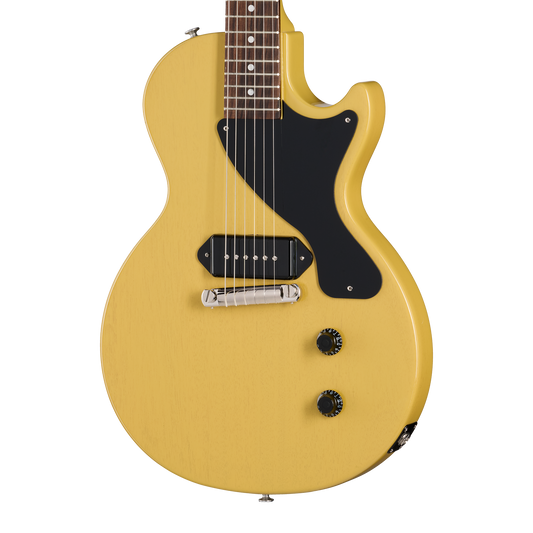
 The Gibson Les Paul Junior in TV Yellow
Gibson Les Paul Junior
We’re now into the realms of the iconic Gibson Original Collection. If you want a classic Les Paul Junior, start here. The Gibson Les Paul Junior stays largely true to its original 1954 design, built around a slab mahogany body, single P-90 Dogear pickup, 50s style neck profile, and wraparound bridge. It’s one of the most direct and stripped-back guitars in the Gibson lineup, designed to deliver raw, unfiltered tone straight out of the box. With just a volume and tone knob, don’t underestimate its versatility—it can do almost anything you need it to and its sound transcends genres.
 The Gibson Les Paul Junior Faded in Tobacco Burst Satin
Gibson Les Paul Junior Faded
The Gibson Les Paul Junior Faded takes the classic 1954 Junior formula but pairs it with a satin nitro finish that takes the ultimate stripped-back guitar design and makes the playing experience even more tactile. Again, you have that 50s-style neck profile, but here the no-frills character of a Junior has more of a worn-in, workhorse-style finish. If you want a guitar that’ll age more quickly than its gloss siblings, this is for you.
 The Gibson Les Paul Junior Double Cut in British Racing Green
Gibson Les Paul Junior Double Cut
The Gibson Les Paul Junior Double Cut builds on the original Junior design with the double-cutaway body introduced in 1958, giving you full access to the upper frets. It keeps the same core formula in the slab mahogany body, single P-90 Dogear pickup, and wraparound bridge, but the mahogany neck with SlimTaper profile makes the difference here—it’s a faster, sleeker design ideal for those with smaller hands.
 The Gibson Custom 1957 Les Paul Junior Reissue, Heavy Aged in Vintage Sunburst
Gibson Custom 1957 Les Paul Junior Reissue
If you want to step back in time and get a Les Paul Junior based on models from the year that most vintage aficionados claim the Junior came into its own, this is it. The Gibson Custom 1957 Les Paul Junior Reissue is a historically accurate recreation staying true to the original formula with a solid, single-cutaway mahogany body, one Gibson Custom Dogear P-90, and a wraparound bridge, built using traditional methods like hide glue construction and handwired with vintage-style wiring. With its 50s neck profile and period-correct specs, it’s designed to capture the exact look and feel of a 1957 model. In addition, Murphy Lab Heavy Aging adds the final layer, recreating the wear and character of a well-played original.
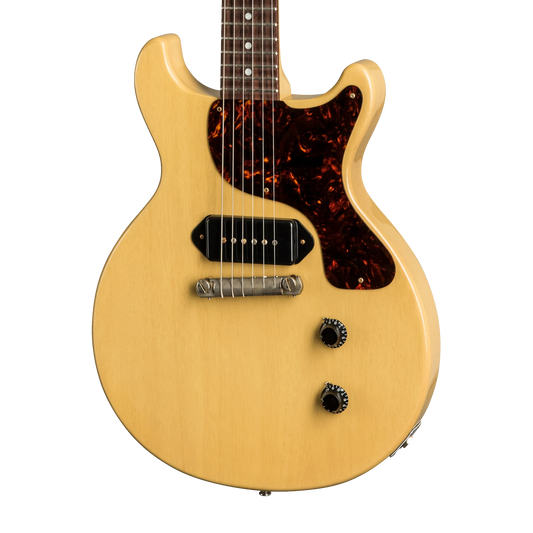
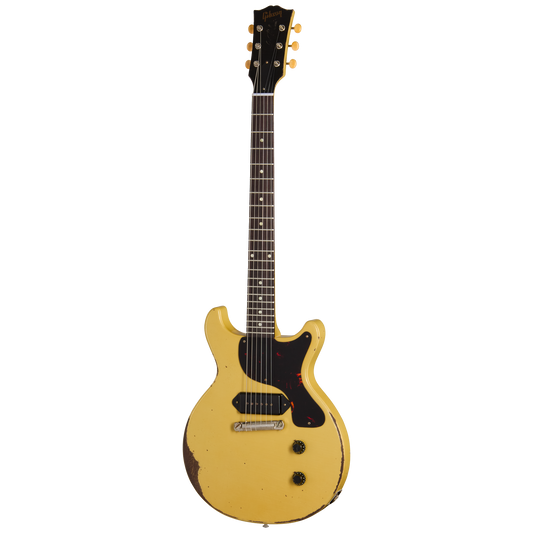
 The Gibson Custom 1958 Les Paul Junior Reissue VOS in TV Yellow
Gibson Custom 1958 Les Paul Junior Reissue
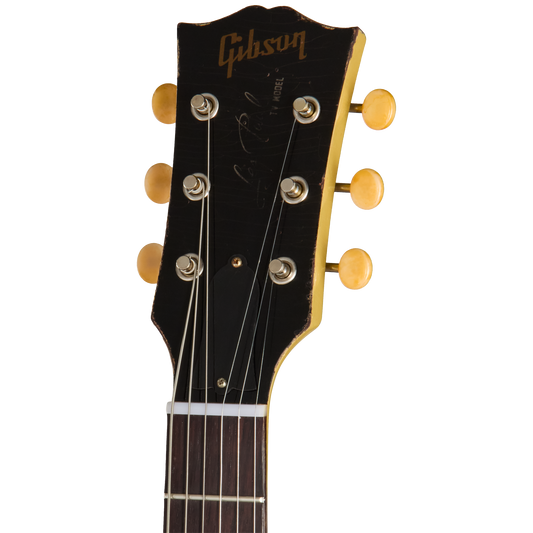
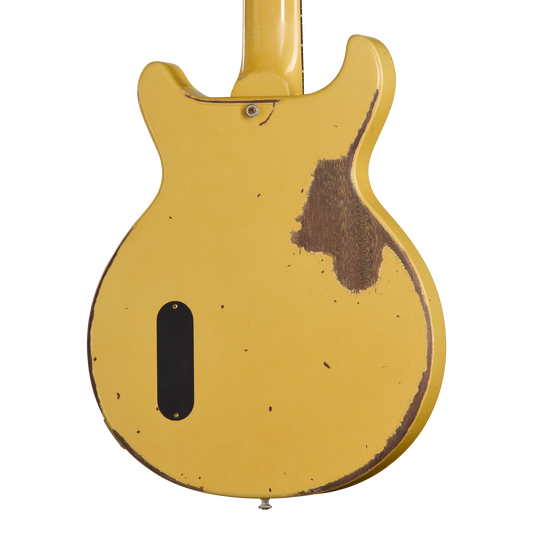
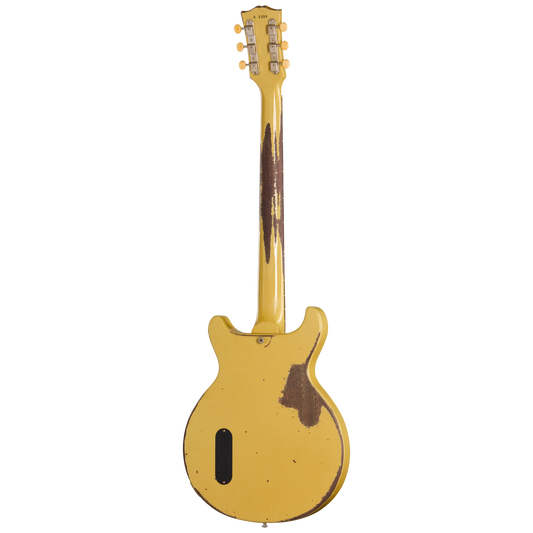
The Gibson Custom 1958 Les Paul Junior Reissue captures the moment the Junior evolved into its double-cutaway shape. It features a solid mahogany body, 50s Rounded Medium C neck profile, Gibson Custom Dogear P-90, and wraparound bridge. Again, it’s built using traditional methods like hide glue construction and handwired vintage-style with CTS 500K Audio Taper Potentiometers and Paper-in-Oil Capacitors.
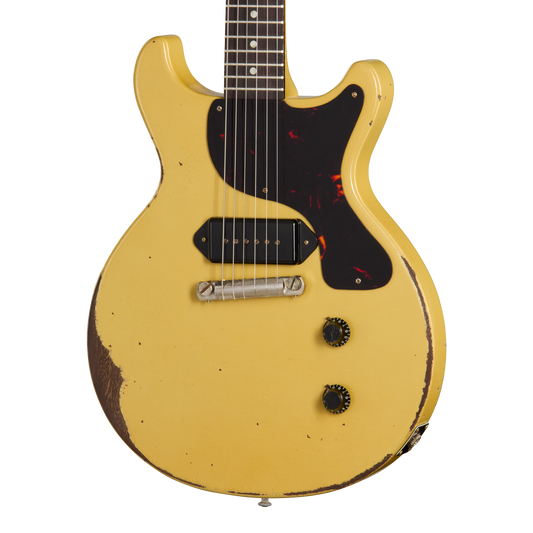
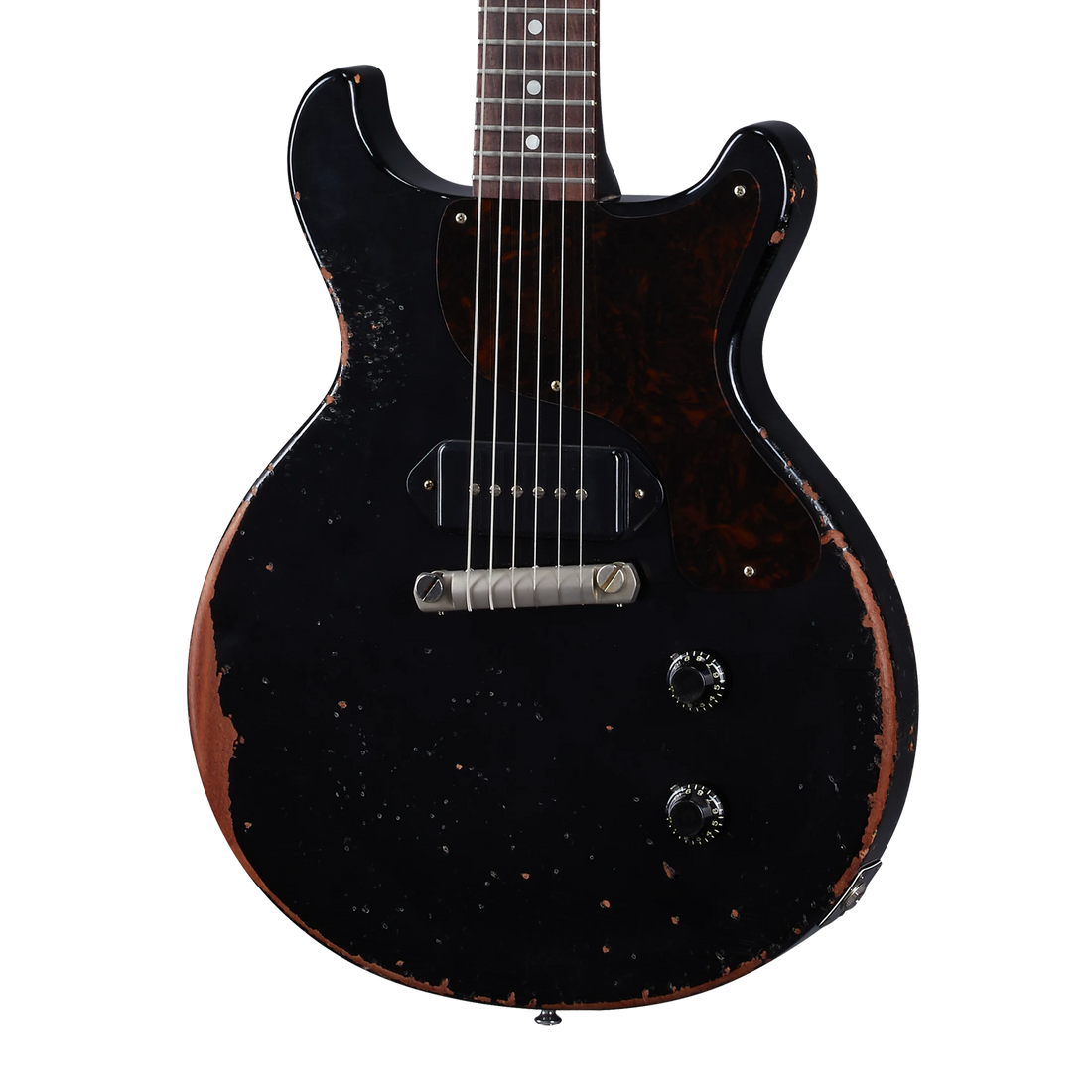 Gibson Custom 1960 Les Paul Junior Double Cut Reissue, Ultra Heavy Aged in Ebony
Gibson Custom 1960 Les Paul Junior Reissue
The Gibson Custom 1960 Les Paul Junior Reissue represents the point where the model became faster and easier to play, combining the double-cutaway body with a slimmer 60s SlimTaper neck profile. It keeps the core formula, while Murphy Lab Ultra Heavy Aging delivers the look and feel of a heavily played original model with decades of stories to tell.
Which Les Paul Junior is best for you?
If you're still trying to figure out which Gibson or Epiphone Les Paul Junior is the best one for you, there’s really no wrong answer, but it mainly comes down to budget, whether you prefer the single or double-cutaway body style, and your favored neck profile.
For the price-conscious, Epiphone is a great place to start, staying true to the student-model spirit of the originals. At the other end of the scale, Gibson Custom Les Paul Juniors with Murphy Lab aging are close as you can get to the Gibson Certified Vintage experience. And Gibson Custom Select is the place to go if you are looking for Juniors with cool specifications and finishes that were never available the first time around during the Golden Era.
But no matter which Les Paul Junior you choose, you’ll be joining a very special club alongside some of the coolest guitarists ever to take to the stage. With six strings, one pickup, two controls and the truth, the sky’s the limit.
Shop the full range of Les Paul Junior guitars here, and read our complete Les Paul comparison here.