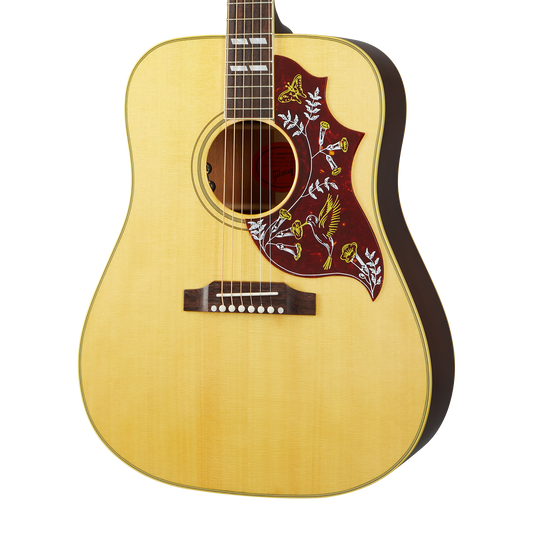
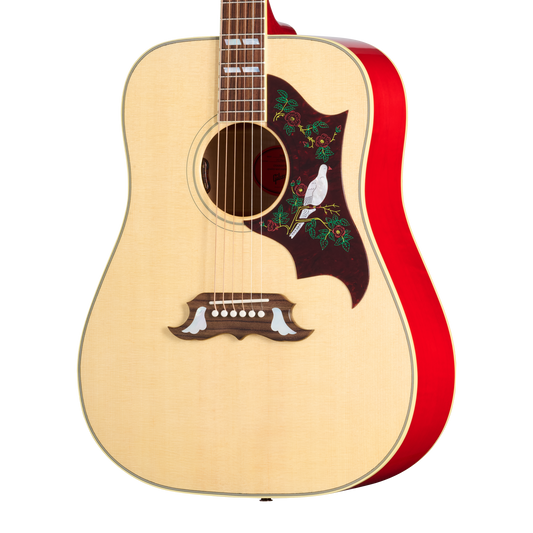
Explore the shapes, sizes, and sounds of the most popular Gibson acoustic guitar body types
For 100 years, Gibson flat-top acoustic guitars have come in a variety of iconic body shapes and sizes. Which size is best for you, and how do those sizes change the way a guitar sounds? To pick up a Gibson acoustic guitar for the first time is the beginning of a musical journey. Whether you’re a beginner learning to play easy acoustic guitar songs or a stage veteran looking to expand your collection with a Gibson instrument featuring cutting-edge pickup technology, the best acoustic guitars conjure visions of both at-home fun and worldwide fame—of campfire jams, open mic nights, and festival shows.
But first, which Gibson acoustic guitar model, shape, and size is best for you? If you are unfamiliar with the variety of different acoustic guitar body styles and sizes, you’ve come to the right place. In this guide to Gibson acoustic guitar body types, we’ll be exploring the shapes, sizes, and sounds of the most popular Gibson acoustic guitar body types.
A brief acoustic guitar anatomy lesson
Before we dive into acoustic guitar shapes in general, and Gibson acoustic guitar shapes specifically, it’s worth clarifying some terminology. Just as discussing bodies in medical school would be tough without anatomical knowledge, referring to guitar bodies is a challenge without understanding their structure. Picture a guitar resting vertically on a stand. For the purposes of our discussion, from top to bottom, the three most important parts of an acoustic guitar’s body are:
- The upper bout. This is the section of the guitar closest to the neck. It’s traditionally symmetrical in non-cutaway acoustic guitar designs, though acoustic guitars with cutaways break with that tradition and allow you to reach the upper frets more easily.
- The waist. This is the narrowest part of the guitar body. In most cases, the soundhole aligns with or sits just in front of the waist.
- The lower bout. This is the area behind the bridge and typically the widest point of the guitar.
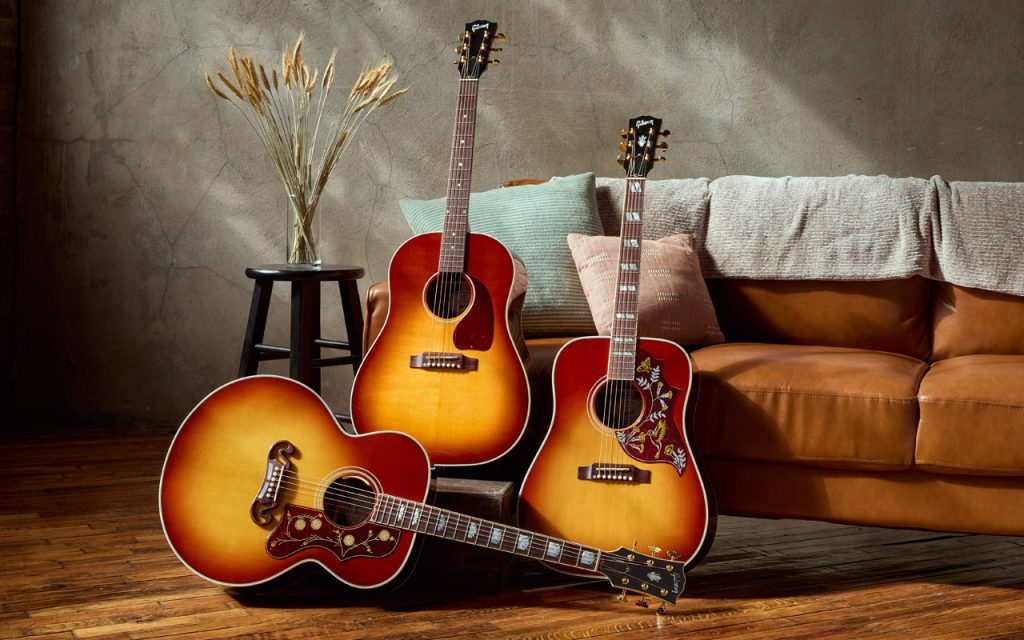 The Gibson Standard Rosewood versions of the iconic J-200, J-45, and Hummingbird
The impact of a guitar’s size and shape
Now that you know your anatomy, we can explore the different acoustic guitar types together. As you might imagine, guitars are designed differently for specific reasons. The size and shape of an acoustic guitar play a significant role in several ways.
First and foremost, size and shape impact the sound and timbre of every guitar type. Think of the inside of an acoustic guitar as a room. The size and shape of that room influence its acoustics—how sound moves within it. Clap your hands in your bedroom and in an empty warehouse, and you’ll hear two very distinct sounds.
Sound also resonates differently in different guitars. Smaller-body acoustic guitars like the Gibson L-00 produce more midrange-forward sounds with less bass. Larger jumbo-sized acoustic guitars like the Gibson SJ-200™ offer a more widescreen tonality with more bass and more high-end sparkle.
Of course, other factors impact the way a guitar sounds, including the tonewoods used, types of strings used, and most of all, the player. Any guitar strummed hard with a heavy pick will sound drastically different than when it is lightly fingerpicked, but the beauty of Gibson acoustic guitars is that their wide dynamic range rewards all playing approaches.
Speaking of playing techniques, the proportions of a guitar also impact how it feels in your hands. Guitarists with a shorter wingspan may appreciate the intimate and approachable feel of a small-body parlor guitar like the L-00. Taller people may enjoy the real estate of a jumbo such as the Gibson SJ-200. And if you are looking for something in-between those poles then the square-shouldered Gibson Hummingbird™ will do the trick.
Shape plays an equal role in playability. If you sit down to play acoustic guitar, your strumming or picking arm will rest differently on a wide-bottomed jumbo than it would on a small-bodied instrument. The best way to get a feel for any guitar is to try it out. But if you can’t make it to the Gibson Garage or an authorized Gibson dealer, this guide is the next best thing. Next, let’s talk acoustic guitar types.
 L-R: Gibson L-00, J-45, Hummingbird, and SJ-200 acoustic guitars
What are the different Gibson acoustic guitar shapes?
Gibson acoustic guitars come in small body, round shoulder, square shoulder (dreadnought), jumbo, and super jumbo shapes, each offering unique tonal qualities. Here’s a quick comparison; read on further for a more in-depth look at the main Gibson acoustic guitar shapes.
Small body guitars like the L-00 and LG-2 provide a compact, focused tone. In comparison, round shoulder acoustic guitars such as the J-45™ and Southern Jumbo offer a fuller tone and greater projection. They provide a balanced sound with clear, bright highs, rich midrange warmth with a distinctive growl when you dig in that’s pure Gibson, and a punchy low-end response.
Square shoulder guitars like the Hummingbird and Gibson Dove™ deliver more sparkle, and typically have a more balanced response across the lows, mids, and highs. They’re great all-rounder guitars and the Dove in particular offers a more hi-fi experience thanks to its longer scale length.
Jumbo and Super Jumbo guitars such as the SJ-200 and J-185 offer an even more expansive sound with a percussive quality that works superbly when driving a band. People often assume that an SJ-200 will automatically produce more bass than a smaller round-shoulder acoustic but this isn’t necessarily the case—the narrow waist of a jumbo attenuates low end to ensure things never get too boomy.
Every Gibson acoustic guitar shape caters to a variety of musical styles, with flexibility across genres. And don’t be frightened to break the rules—over the years there have been incredible fingerpicking performances with SJ-200s and J-45s, and a strummed L-00 has a really characterful sound. You can watch an entire video on the sonic and anatomical differences between each of the main Gibson acoustic guitar shapes below:
 L-R: Gibson L-00 Special, L-00 Standard, and LG-2
Gibson small-body guitars
These instruments are slightly larger than what would typically be considered a parlor guitar but smaller than what you might imagine as a “standard” acoustic. Due to their compact dimensions, Gibson small-body guitars like the L-00 and LG-2 have been at-home and studio staples since their inception and make ideal guitars for travelling musicians.
Today, you’ll often see small-body Gibson acoustic guitars onstage with Americana and indie bands—as well as the solo fingerstyle folk and blues players who have favored them for nearly a century. Their focused tonality is particularly useful because it sits naturally in a mix while retaining its distinctive midrange-rich voice. You can hear their voice, but it’s not overbearing.
Body shape characteristics and sound profile
Gibson small-body acoustic guitars like the L-00 and LG-2 tend to have a slim waist and a relatively narrow upper and lower bout. As such, they are lightweight, portable, with an appealing intimacy that makes them as inspiring as they are easy to pick up and play.
Known for their sonic clarity and focus, Gibson small-body acoustics have an appealing midrange warmth, an articulate dynamic response, and a harmonic complexity favored by fingerpickers. Small-body acoustic guitars tend to be quieter than their larger counterparts, but that doesn’t mean they disappear in the mix—and we’ve played many exceptions to the rule that exhibit remarkable projection for their size.
Examples of Gibson small-body acoustic guitars
- The Gibson L-00 plays a massive part in the history of small-body guitars. It was described as a guitar with “perfect balance” in the 1934 Gibson catalog, and that accolade still rings true today. Just ask Margaret Glaspy.
- With a rich sound that belies its diminutive size, the Gibson LG-2 was launched in 1942 and is ideal for blues, folk, and fingerpicking styles, though it’ll gladly take on any genre.
 The Gibson J-45 60s Original
Gibson round-shoulder guitars
The round-shoulder acoustic guitar, also known as a slope-shoulder acoustic, is the most recognizable and iconic of all Gibson acoustic guitar shapes. Models such as the J-45 and Southern Jumbo feature this distinctive silhouette, which combines the large body of a dreadnought-style acoustic with gently sloping shoulders.
Gibson introduced the J-45 in 1942. It has since become one of the most-celebrated and most-recorded instruments in music history and is our best-selling acoustic guitar of all time. Known affectionately as “The Workhorse,” the elegantly simple J-45 has been used across a remarkably wide range of genres and remains the defining example of the Gibson round-shoulder acoustic guitar design. It’s hard to find a concert stage or recording studio in which this guitar doesn’t regularly appear.
Body shape characteristics and sound profile
For most acoustic players, the J-45 sits squarely in the Goldilocks zone of size and comfort. With a large, dreadnought-sized lower bout but rounded shoulders that give it a slightly refined feel, it’s no surprise that the J-45 has given birth to more hit songs than any other guitar model we can think of. Variants of the Gibson round-shoulder design such as the J-45, J-50, J-35, and Southern Jumbo have been used by music icons in every genre.
A typical Gibson round-shoulder guitar like the J-45 delivers a midrange-rich tone with exceptional warmth and clarity, perfectly complementing the human voice. Dig in with a pick and the signature J-45 snarl and natural compression is there in abundance; sit back and pick gently and you’ll be rewarded with a beautiful, characterful tone for fingerstyle. Compared to a small-body guitar like the L-00, there’s more bass and more projection, but it’s still a perfectly balanced instrument and unsurprisingly, a go-to for record producers. Find out more about why the J-45 is so special here.
Examples of Gibson round-shoulder acoustic guitars
- The J-45 is hands down the best-selling Gibson acoustic guitar of all time—a workhorse and a musical companion for life that’s equally at home on stage, in the studio, or picking around the house. Everyone should own one of these guitars.
- The Southern Jumbo was introduced in 1942 as an upscale alternative to the J-45, with more elaborate inlays and binding. Its round-shoulder tone is every bit as iconic.
 L-R: Gibson Hummingbird Original and Dove Original
Square-shoulder guitars
The square-shoulder design is another one of Gibson’s most iconic acoustic body shapes, and it can be seen on legendary models like the Hummingbird, Country Western, and Dove. They are part of the dreadnought family, with the unique Gibson square-shoulder style combining a broad upper bout and commanding visual presence with a powerful, balanced sound, giving them a distinctive look and tone.
Body shape characteristics and sound profile
A square-shoulder dreadnought is what most people see in their head when they imagine an acoustic guitar and the broader upper bout—almost big enough to balance a drink on but we don’t advise it!—delivers a little more bass and high-end sparkle than a typical round-shoulder design. You might get a little boost in projection, too, but this varies from guitar to guitar.
Traditionally, Gibson has used the extra real estate on the soundboards of its square-shoulder models like the Hummingbird and Dove to offer more ornate aesthetic adornments such as larger and more elaborate pickguards with engraved designs. They certainly make a timeless visual statement and the same can be said of their sonics—for a great all-round acoustic guitar with exceptional balance that excels in every genre, it’s hard to beat a Gibson square-shoulder acoustic guitar. But there are important differences between the main models.
Examples of Gibson square-shoulder acoustic guitars
- With its distinctive pickguard artwork, square-shoulder body, and balanced tonal response, the Gibson Hummingbird is one of the most recognizable Gibson acoustic guitars. If you want a less ornate alternative, try the Country Western.
- The Gibson Dove shares a square-shoulder silhouette but possesses its own visual identity, with an elegant bridge and distinctive pickguard, along with a longer 25.5-inch scale length that contributes to a slightly brighter and more hi-fi sound. Compare to the Hummingbird’s 24.75-inch scale, the Dove has a slightly higher string tension, more projection, and a snappier response that’s well-suited to flatpicking and lead work. It’s no coincidence that the Dove is enduringly popular with country players.
 The Gibson SJ-200 Original
Gibson jumbo and Super Jumbo guitars
Finally, we come to the largest Gibson acoustic guitars. Models such as the J-185 and even larger SJ-200™ make a real statement onstage—both aesthetically and sonically. Although their evolution was driven by a demand from players for more volume, there’s no doubt that the emergence of television was a factor in the appeal of these head-turning instruments, many of which were custom-ordered with even more elaborate inlays and adornments in the singing cowboy era.
Body shape characteristics and sound profile
Jumbo and Super Jumbo guitars are totally unmistakable thanks to those large, rounded upper and lower bouts with fairly narrow waists. It’s an eye-catching silhouette that pushes plenty of air but the narrow waist helps control the low end so proceedings don’t get too boomy. The SJ-200 is the biggest acoustic guitar in the Gibson catalog, while the J-185 offers a similar experience in a slightly more compact size that better suits players of a smaller stature.
Both the SJ-200 and J-185 are characterised by a bright, percussive attack and a balanced voice for strumming that works equally well when driving a band or accompanying a solo singer-songwriter. The maple back and sides on most SJ-200 models contributes presence and an ethereal shimmer that makes even the simplest first-position cowboy chords sound magical. The SJ-200 has been a familiar sight on stages for generations, and the combination of a huge body with a controlled, articulate response is a big part of what makes the Gibson SJ-200 so special.
Examples of Gibson jumbo and Super Jumbo acoustic guitars
- The Gibson SJ-200 is known as the “King of the Flat-Tops” and its Super Jumbo body shape delivers serious projection and percussive attack. If you’re comparing the SJ-200 with square-shoulder Gibson acoustics, take a look at our comparison between the Gibson Hummingbird and the SJ-200.
- The Gibson J-185 takes the jumbo concept and scales it down slightly, offering a more compact body while retaining plenty of the aesthetic and sonic signature that makes larger-bodied Gibson acoustic guitars iconic.

Choosing the perfect fit: Find your Gibson guitar
Writing about sound only gets you so far. Words like “punchy,” “warm,” and “percussive” mean slightly different things to different players, and it all depends on the player, the guitar, and how it’s being approached. The best way to figure out which Gibson acoustic shape is right for you is to try a few out in person, hear how they respond to your playing style, understand how the different body sizes feel in your hands, and work out which model you find the most inspiring.
Whichever Gibson acoustic model you choose, it’s part of a 100-year tradition of Gibson flat-top designs and handcrafted with love by a team of artisans in Bozeman, Montana. Each Gibson acoustic guitar shape brings something different to the party, but they are all built to inspire.
Explore the full range of Gibson acoustic guitars on Gibson.com then visit the Gibson Garage or an authorized Gibson dealer to try your favorites in person. Still narrowing it down? Compare the Gibson Hummingbird to the SJ-200 or take a closer look at the differences between the J-45 and the Hummingbird.