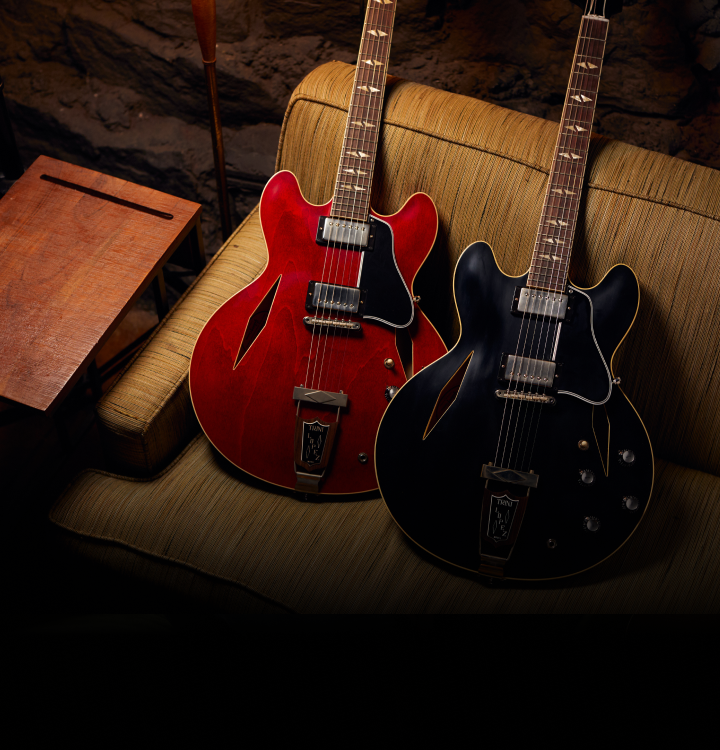
Historic Carved Tops


Orville Gibson produced the first carved top guitars in the early 1900s as a direct result of his application of mandolin design to guitar production. However, it was not until the early 1920's when Lloyd Loar introduced a Gibson L-5 with violin-type f-holes that Gibson's carved top guitars began to gain dominance over the banjo as the popular instrument of the day. Throughout the roaring twenties Gibson's L-5 was the only model in the Gibson line that featured this attribute. Then in the early 1930s, Gibson responded to increasing competition with several new models. Promoting its line of instruments as superior and incomparable, Gibson set it sights on the competition. By 1935 the L-5 advanced to a body width of 17 inches. Additionally, Gibson introduced a new standard of excellence - the Super 400. With its intricate appointments and body width of 18 inches the Super 400 was soon to be one of the most copied guitars of its day. Gibson's history of innovation once again prevailed. The L-5 and Super 400 set historic instrument precedents that continue today.

Gibson's famous ES (Electric Spanish) Collection dates back to the ES-150 model in 1936. In 1933 a gentleman named Walter Fuller joined Gibson, and was soon assigned responsibility for electrifying acoustic arch top guitars. From his earliest "Charlie Christian" pickup, through numerous pre-war designs, Fuller's experiments were aimed at amplifying pure acoustic sonorities with as little electrical coloration as possible. However, in the days before World War II, the ES Collection probably seemed like just another passing fad, so these instruments achieved only modest success. The death of Charlie Christian in 1942, and the commencement of war-related production work, meant that the success of these electric guitars would have to wait. Later, a decade after the ES-150, guitarists such as electric jazzmen Barney Kessel, Johnny Smith, Tal Farlow and Herb Ellis and bluesmen T-Bone Walker, Muddy Waters, Elmore James, B.B. King and Chuck Berry emerged with demands for new style electric instruments. Many leading players now expressed their preference for a less lively top, choosing to limit acoustic resonance in favor of a clearer, more defined string sound. Gibson enhanced its traditional construction philosophies, and redesigned the pre-war ES-150 and ES-300 by affixing a laminated maple top to solid maple rims and back. In developing good tone wood laminates - which are worlds away from lumberyard plywood - Gibson revolutionized woodworking technology, much as Orville Gibson had with solid blocks of tone wood some sixty years before. By creating a controllable acoustic box, and downplaying top and back vibrations, Gibson reduced feedback - while retaining the fat, woody, percussive attack of a hollow body. All through the '50s Gibson expanded the ES Collection with both top- of-the-line and entry level models. Then, with the introduction of the single cutaway ES-350, Gibson crafted an entire guitar from pressed maple laminates.

Gibson's Historic engineers have applied the same attention to detail to the carved top and ES style guitars in the Historic Collection as they have applied to Historic Collection solid body electrics. Each guitar has received extensive research. Specific carving dimensions and cosmetic appointments have been identified. Some of the original carving dies still exist and are put to use carving instruments such as the Super 400 and L-5. Of interest is the fact that some of the same craftsman who helped produce instruments such as the Citation and custom L-5s in the early 1960s lend their skilled hands to these exquisite guitars. These instruments are truly historic investments and will bring home history to any modern collector.

Carved Top Series

 
Custom Shop Custom Collection Art Guitars Historic Collection Limited Editions GMI Divisions